
Is AI Search Visibility Worth It? What 3 New Studies Found

If you’ve sat through a marketing planning meeting in 2026, you’ve probably heard some version of this pitch: AI search is the future, so you need to invest in “GEO” — generative engine optimization — to show up inside ChatGPT, Gemini, and AI Overviews. It’s a reasonable-sounding idea. But three independent analyses published within the same week in October 2026, each using real website analytics rather than platform-reported figures, arrived at a strikingly consistent and much less dramatic picture of how much traffic AI assistants actually send today.

Here’s what the data shows, what it doesn’t prove, and how to think about your own 2027 budget in light of it.

Is AI Search Visibility Worth It? What 3 New Studies Found

The Three Studies, in Plain Terms

1. Marie Haynes — “GEO is a distraction”

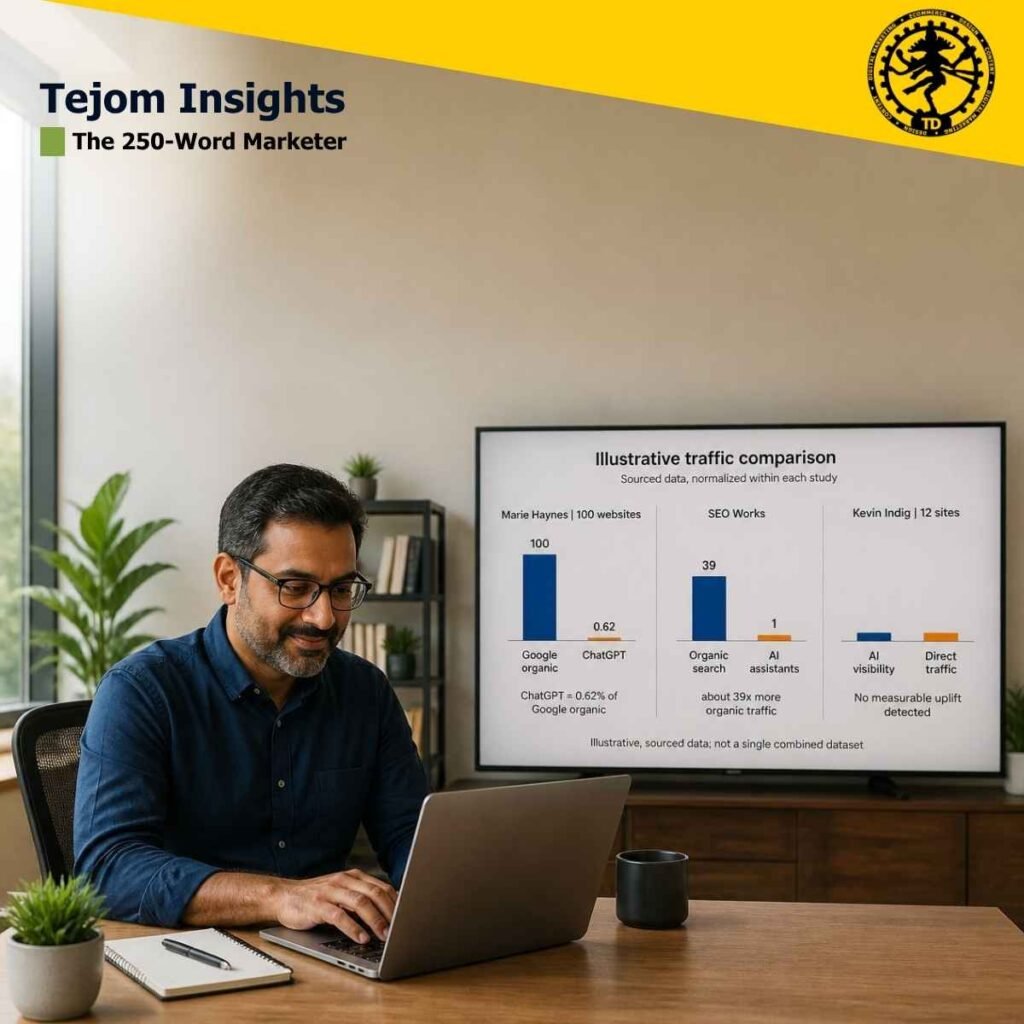
Haynes analyzed 12 months of Google Analytics 4 data across 100 websites of varying size, totaling more than 145 million sessions. She found that sessions arriving from ChatGPT amounted to just 0.62% of the volume driven by Google organic search. Interestingly, ChatGPT visitors converted at a notably higher rate — 13.8%, versus 3.02% for Google organic visitors. But because the volume gap is so large, Google organic still accounted for 96.5% of total conversions across the channels she analyzed, and drove roughly 27 times more conversions than all AI assistants combined.

SEO Works — “How Much Traffic Do AI Assistants Actually Send, And Does It Convert Better?”

This analysis (sample size not disclosed in available reporting) found that organic search delivered about 39 times more traffic than AI assistants. For every 100 conversions organic search produced, AI referral traffic produced about 3.2. AI referral traffic converted worse than paid search (at roughly 0.67 times the rate) but better than direct traffic (about 2.48 times).

3. Kevin Indig (Growth Memo) — “Does AI drive more direct traffic?”

Looking across 12 sites in different sectors, Indig could not detect a measurable increase in direct traffic to long-tail pages that would suggest AI assistants are quietly driving unattributed (“dark”) traffic. He found no reliable relationship between AI visibility and branded search or direct traffic — while being careful to note that an absence of a detectable effect in his sample isn’t proof that no such effect exists anywhere.

The Nuance the Headlines Miss

It’s tempting to read “AI sends almost no traffic” and conclude AI search doesn’t matter. That’s too simple, for two reasons.

First, Haynes’s own data shows AI-driven visitors convert at more than four times the rate of Google organic visitors. The traffic volume is small, but the quality — at least in her dataset — is notably higher. That looks less like “AI search doesn’t matter” and more like “AI search currently sends a small number of unusually high-intent visitors.”

Second, there’s a real attribution problem underneath all three studies. Analytics tools can struggle to correctly tag traffic that originates from an AI assistant’s answer, especially when a user copies a link or searches separately after reading an AI summary — this can get misclassified as “direct” traffic. Indig’s study was specifically looking for this effect and couldn’t confirm it, which is useful, honest evidence — but it’s evidence of absence in his 12-site sample, not proof that it doesn’t happen more broadly.

It’s also worth sizing the AI side of this correctly. OpenAI’s own head of ChatGPT search, Adam Fry, said in a November 4, 2026 interview that ChatGPT’s search-like query volume is roughly one-fifth of Google’s, and that ChatGPT’s user base grew from 1 billion to 1.2 billion in the preceding two months. That’s a measure of how much people are using ChatGPT to ask things, not how much referral traffic it sends to websites — a distinction worth holding onto, since the two numbers answer different questions.

What These Studies Do — and Don’t — Prove

Be precise about what’s actually been measured here. All three studies report traffic volume and conversion rates. None of them calculate a return on investment for GEO spending — that would require knowing the cost of the AI-visibility work being evaluated, which none of the three studies address. The framing that AI visibility is “not worth investing in” is a reasonable interpretation of the traffic numbers, but it’s an editorial conclusion, not something the underlying data directly proves.

It’s also worth being upfront about limits: Haynes’s sample mixes websites of different sizes and industries; SEO Works hasn’t published its sample size; and Indig’s 12-site sample is small. None of the three studies publish an India-specific breakdown.

What This Means for Your 2027 Marketing Budget

A few practical conclusions, held carefully against what the data actually shows:

  1. Don’t deprioritize traditional SEO. By every study cited here, Google organic search remains the overwhelmingly larger traffic and conversion channel today.
  2. Don’t dismiss AI referral traffic either. Where it’s been measured, it tends to convert differently — sometimes notably better — than other channels, suggesting the people it does send are further along in their decision.
  3. Check your own numbers before changing your budget. Segment your GA4 referral data for chatgpt.com, perplexity.ai, gemini.google.com, and similar sources, rather than applying a global average to your specific business and audience.
  4. Treat GEO as an incremental layer, not a budget replacement, until more — and more India-relevant — data exists.
  5. Revisit this in a few months. This is early-stage, largely US/UK-weighted research. Expect more studies, and be ready to update your view as better data arrives.

Key Takeaways

  • Three independent October 2026 studies, using real analytics data, all found Google organic search drives far more traffic and conversions than AI assistants combined — by roughly 27 times to 39 times, depending on the study.
  • At least one study found AI-referred visitors convert at a meaningfully higher rate than Google organic visitors, even though their volume is small.
  • None of the three studies calculate a return on investment for AI-search optimization spend; “not worth investing in” is editorial framing, not a stated research finding.
  • None of the studies publish India-specific data — check your own GA4 referral sources before changing your budget based on global research.

Stop guessing where your traffic is coming from.

Before shifting your 2027 marketing budget into GEO, audit your own data and measure exactly how much high-intent traffic ChatGPT, Gemini, and Perplexity are driving to your site today.

A 15-minute session?

Take the first step toward future-proof growth:

  • For a Direct Business Query: Call us at  99034 72194

  • For a Quick Consultation: WhatsApp our team at 79807 31010

FAQs

  1. Is AI search visibility worth investing in for SEO and marketing?
    Three October 2026 studies found AI assistants currently send a small fraction of the traffic and conversions that Google organic search does. Whether it’s “worth investing in” depends on your specific cost of effort, since none of the studies calculate a return on investment directly.
  2. How much traffic do AI assistants like ChatGPT actually send to websites?
    Across the studies cited, estimates range from about 0.62% of Google organic session volume (Marie Haynes’s 100-site analysis) to roughly 1/39th of organic traffic (SEO Works).
  3. Does ChatGPT traffic convert better or worse than Google organic traffic?
    In Marie Haynes’s dataset, ChatGPT visitors converted at 13.8%, versus 3.02% for Google organic visitors — notably higher, despite the much smaller volume.
  4. What is GEO (Generative Engine Optimization)?
    GEO refers to optimizing content so it’s more likely to be cited, summarized, or recommended by AI systems like ChatGPT, Gemini, Perplexity, and Google’s AI Overviews and AI Mode.
  5. Are these AI-search-traffic studies India-specific?
    No. All three studies are based on global or US/UK-weighted website data, with no published India-specific breakdown. Indian businesses should check their own analytics rather than assume these ratios apply directly.
  6. Why do some experts say AI visibility doesn’t matter yet?
    Because, across multiple independent analyses using real traffic data, the actual volume of visits and conversions AI assistants currently generate is small compared to Google organic search — though this is a traffic-volume argument, not a definitive ROI calculation.
  7. Could AI-driven traffic be undercounted in Google Analytics?
    Possibly. Kevin Indig’s study specifically tested for this (“dark traffic” misclassified as direct) and did not find clear evidence of it in his 12-site sample — but a small sample not finding an effect doesn’t prove the effect doesn’t exist elsewhere.
  8. What percentage of Google’s search volume does ChatGPT represent?
    OpenAI’s Adam Fry said in a November 4, 2026 interview that ChatGPT’s search-like query volume is roughly one-fifth (about 20%) of Google’s — a measure of usage, not of referral traffic sent to websites.
  9. Should small and mid-size businesses stop tracking AI search visibility?
    No. Even a small, high-converting traffic source is worth monitoring. The data suggests treating it as a secondary channel to watch, not a channel to ignore or over-invest in.
  10. What should a CMO do with this data when planning a 2027 marketing budget?
    Check your own GA4 referral data for AI-assistant sources first, keep traditional SEO as the primary budget priority, and treat GEO spend as a smaller, incremental addition rather than a reallocation away from proven channels.
  11. Do these findings mean AI Overviews and AI Mode don’t matter for Google Search itself?
    No — these studies measure traffic AI assistants send to outside websites, not how AI Overviews or AI Mode affect visibility and clicks within Google Search itself, which is a separate and ongoing area of research.
  12. How can I check my own website’s AI referral traffic?
    In GA4, review your Traffic Acquisition report and look for referral sources such as chatgpt.com, perplexity.ai, gemini.google.com, and copilot.microsoft.com, then compare their session and conversion volumes against your organic search channel.

#AISearch #GEO #SEO #MarketingBudget2027 #ContentStrategy #ChatGPTAds #AIOverviews #DigitalMarketing #B2BMarketing #MarketingROI #TejomDigital

Chhath Puja 2026 Marketing Strategy: Beyond the Diwali Afterthought
The 250-Word Marketer
Naina Adhikari

Chhath Puja 2026 Marketing Strategy: Beyond the Diwali Afterthought

Diwali 2026 just wrapped. For brands with any reach into Bihar, Jharkhand, or eastern UP communities, Chhath Puja — falling November 13-16 — is a second, genuinely separate festive moment. Here’s a chhath puja 2026 marketing strategy built on what brands actually did last year, not assumptions.

Read More »