Google NielsenIQ Agentic Commerce: What It Means for Marketers

Every few weeks this year, another company has announced an “agentic commerce” feature — a chat-based shopping assistant, an in-app buy button, an AI agent that compares products on your behalf. Most of these have been consumer-facing. On October 29, 2026, Google and NielsenIQ (NIQ) announced something different: a partnership aimed squarely at the data and measurement infrastructure that sits behind all of it.
This matters for a simple reason. Every flashy AI shopping agent needs two unglamorous things to actually work: accurate product data, and a reliable way to measure whether the spend behind it is paying off. This announcement is about both.

Google NielsenIQ Agentic Commerce: What It Means for Marketers

What was actually announced

Google and NIQ describe this as a “broad collaboration to advance agentic commerce,” with three distinct parts:

1. Enterprise infrastructure. NIQ is expanding its internal use of Google Cloud and Gemini for business, and has named Google Cloud as a primary AI and cloud services provider. This is largely an internal operations story — NIQ automating its own workflows — but it signals the depth of the partnership.

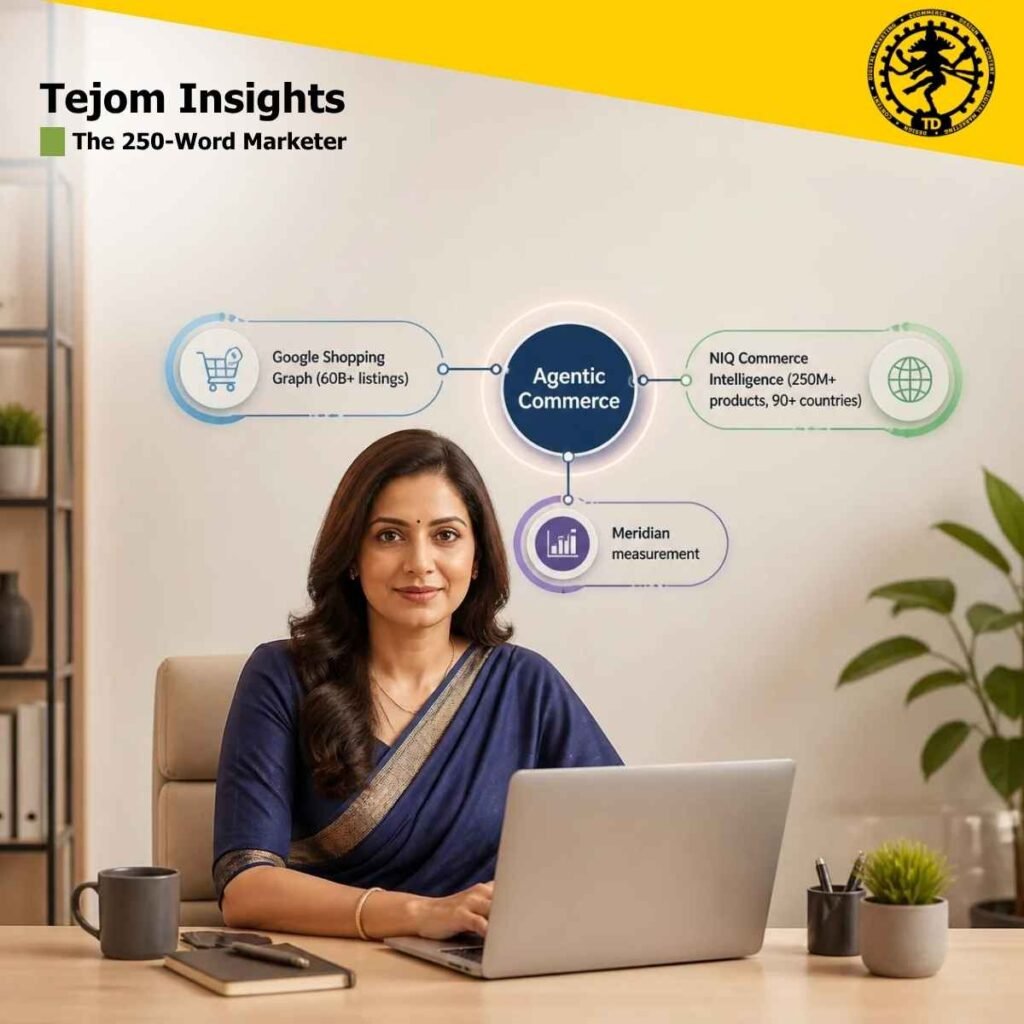
2. Commerce data. This is the part most relevant to marketers. NIQ will bring its Commerce Intelligence to complement Google’s Shopping Graph — which the companies say already holds more than 60 billion product listings. NIQ’s contribution includes Product Intelligence, covering more than 250 million products, and Store Intelligence, built on retail location and sales tracking across more than 90 countries. The stated goal is helping AI systems correctly identify relevant products and assess real local availability — a known weak point for early AI shopping tools, which have sometimes recommended products that are out of stock or unavailable nearby.

3. Measurement. NIQ is integrating Google’s open-source Meridian marketing-mix-modeling framework, including a location-based testing tool called Meridian GeoX, into its own NIQ Cadence measurement platform. In plain terms: brands using NIQ’s measurement tools will be able to feed purchase data into Google’s own modeling approach and run geography-based spend experiments.

Why this is a different kind of agentic-commerce story

Most agentic-commerce coverage this year has been about the visible layer: can a shopper buy something inside a chat window, does an AI agent complete checkout, which platform got there first. Those are real developments, and worth tracking in their own right. But none of them answer a quieter question that matters just as much to a marketing leader: if AI agents are increasingly the ones recommending and comparing products, whose data are they using, and how good is it?
This partnership is a direct answer to that question, at least for one slice of the ecosystem. It does not launch a new consumer feature. It commits two companies — one that owns a massive product graph, and one that has spent decades building retail measurement and data products — to make the underlying data better and the measurement of ad spend around it more consistent.

What this is not

It is worth being precise about the limits here, in the same spirit this project applies to every announcement. This is a joint press release from the two companies involved, not independent, third-party verification of any performance outcome. Phrases like “advance agentic commerce” and quotes from both companies’ executives are, reasonably, optimistic framing of a business partnership. No specific product, feature, or timeline for Indian markets is named anywhere in the announcement. And several related NIQ initiatives mentioned in the release — a ConnectAI Suite, Product Intelligence/Connected Content, and a Commerce Lab — are referenced without detail, so there is little to say about them yet.

What marketers should actually take from this

1. Feed and data quality keeps rising in importance. If AI shopping agents increasingly rely on product graphs like Google’s, the completeness and accuracy of your product data — titles, availability, local stock, pricing — matters for whether an AI agent surfaces your product at all, not just for traditional Shopping ads.

2. Marketing mix modeling is quietly becoming the connective tissue of 2026-era measurement. This is the second major integration of Google’s Meridian framework into a well-known third-party platform this project has tracked this year, alongside NIQ’s own earlier moves. That is a real pattern worth watching, separate from any single vendor’s claims.

3. Don’t confuse infrastructure announcements with available features. Nothing in this release gives an Indian business a new tool to use today. Treat it as a signal of direction, and revisit it when either company publishes a specific, available product tied to this partnership.

4. Keep your own first-party product and customer data clean regardless. Whichever platforms end up mediating AI-driven shopping, businesses with accurate, well-structured product and customer data will be better positioned than those without it.

Key Takeaways

  • On October 29, 2026, Google and NielsenIQ announced a partnership combining NIQ’s retail data (250M+ products, 90+ countries of store data) with Google’s Shopping Graph (60B+ listings) and Meridian measurement framework.
  • This is an infrastructure and measurement story, not a new consumer-facing shopping feature.
  • It is a joint vendor announcement, not independently verified performance data — treat optimistic framing as framing, not proof.
  • No India-specific detail is included in the announcement.
  • The practical takeaway for any business is unchanged either way: clean, accurate product and customer data matters more, not less, as AI increasingly mediates product discovery.

Prepare Your Data for the Next Era of Commerce.

As platforms like Google and NIQ build the backbone for agentic shopping, data quality is becoming your greatest competitive advantage. Download our checklist to evaluate your first-party product data and measurement frameworks.

A 15-minute session?

Take the first step toward future-proof growth:

  • For a Direct Business Query: Call us at  99034 72194

  • For a Quick Consultation: WhatsApp our team at 79807 31010

FAQs

  1. What did Google and NielsenIQ actually announce?
    A partnership, announced October 29, 2026, combining NIQ’s retail and product data with Google’s Shopping Graph and Google’s Meridian marketing-mix-modeling framework, to support what both companies call “agentic commerce.”
  2. Is this a new product I can use today?
    No. It is a partnership announcement describing a direction of work, not a shipped, available product for businesses to adopt immediately.
  3. What is Google’s Shopping Graph?
    A Google database of product listings used to power Shopping ads and AI shopping features. The companies state it holds more than 60 billion product listings.
  4. What does NIQ bring to the partnership?
    Commerce Intelligence, including Product Intelligence (250 million-plus products) and Store Intelligence (retail location and sales data across 90-plus countries), plus its NIQ Cadence measurement platform.
  5. What is Meridian, and why does it matter here?
    Meridian is Google’s open-source marketing-mix-modeling framework, used to help brands understand which marketing channels are actually driving results. NIQ is integrating it, including a location-testing tool called Meridian GeoX, into its own measurement platform.
  6. Is there any India-specific detail in this announcement?
    No. Neither company’s release names India, an Indian market, or an Indian rollout timeline.
  7. Is this independent proof that agentic commerce works?
    No. This is a joint announcement from the two companies involved. It is a genuine, dated development, but it is not independent, third-party verification of any specific performance outcome.
  8. How is this different from Google’s other agentic-commerce features, like AI Mode shopping tests?
    Those are consumer-facing features — things a shopper directly interacts with. This partnership is about the data and measurement infrastructure behind such features, not a feature itself.
  9. Why does product data quality matter more because of this?
    If AI shopping agents increasingly rely on large product graphs fed by data partners, a business’s own product data — accuracy, availability, pricing — affects whether it gets surfaced to an AI agent at all.
  10. What should a marketing team actually do in response to this news?
    Treat it as a direction signal, not an action item. Keep product and customer data clean and well-structured, and revisit this partnership when either company announces a specific, available product tied to it.
  11. Are there other parts of this partnership not yet explained?
    Yes. The announcement references a ConnectAI Suite, Product Intelligence/Connected Content, and a Commerce Lab from NIQ, without further detail. Treat these as open items until more is published.
  12. Does this affect my current Google Shopping or Performance Max campaigns?
    Not directly, and not immediately. This is a data-and-measurement partnership, not a change to existing campaign types or settings.

#AgenticCommerce #GoogleCloud #AIMarketing #ShoppingGraph #MarTech #FutureOfRetail #DigitalMarketingIndia #MarketingMixModeling #TejomDigital

Is AI Search Visibility Worth It? What 3 New Studies Found
The 250-Word Marketer
Naina Adhikari

Is AI Search Visibility Worth It? What 3 New Studies Found

Three independent 2026 studies measured real website traffic and conversions from ChatGPT, Gemini, and other AI assistants against Google organic search — and found AI assistants send a small fraction of the traffic, though the visitors they do send often convert differently. Here’s what the data actually shows, what it doesn’t prove, and how to use it to plan your 2027 marketing budget.

Read More »
Chhath Puja 2026 Marketing Strategy: Beyond the Diwali Afterthought
The 250-Word Marketer
Naina Adhikari

Chhath Puja 2026 Marketing Strategy: Beyond the Diwali Afterthought

Diwali 2026 just wrapped. For brands with any reach into Bihar, Jharkhand, or eastern UP communities, Chhath Puja — falling November 13-16 — is a second, genuinely separate festive moment. Here’s a chhath puja 2026 marketing strategy built on what brands actually did last year, not assumptions.

Read More »
Cheap Agencies, Costly Mistakes: How Unlicensed Content Can Tank Your Brand
Content on Digital Media
Anirban Guha

Cheap Agencies, Costly Mistakes: How Unlicensed Content Can Tank Your Brand

In an era where digital content moves at breakneck speed, cutting corners with budget agencies or unvetted freelancers can invite catastrophic legal liability. This ready reckoner breaks down how unlicensed stock photos, stolen vectors, and unverified media assets can result in hefty copyright penalties under Section 63 of the Indian Copyright Act, forced rebrands, and lasting reputational fallout.

Read More »