Tejom Digital Awarded top 10 Advertising Startup for 2022 by Silicon India - Start Up City
Tejom-Digital-Digital-Marketing-Agency- is an registered MSME

आ नो भद्राः क्रतवो यन्तु विश्वतः

Let noble thoughts come from all directions

50 / 100 SEO Score

Social media marketing agency workflow: A blueprint for Kolkata brands

Social media marketing agency workflow efficiency is the backbone of any scaling business in Kolkata, whether you are a growing MSME or an established corporate. In today’s fast-paced digital landscape, mastering your social media marketing agency workflow is no longer optional—it is a competitive necessity. By integrating robust digital tools, you can transform your social media marketing agency workflow from a chaotic series of tasks into a streamlined, high-output engine.

Published Published Published Social media marketing agency workflow: A blueprint for Kolkata brands

Master the Cloud: The Real-Time Communication Hub

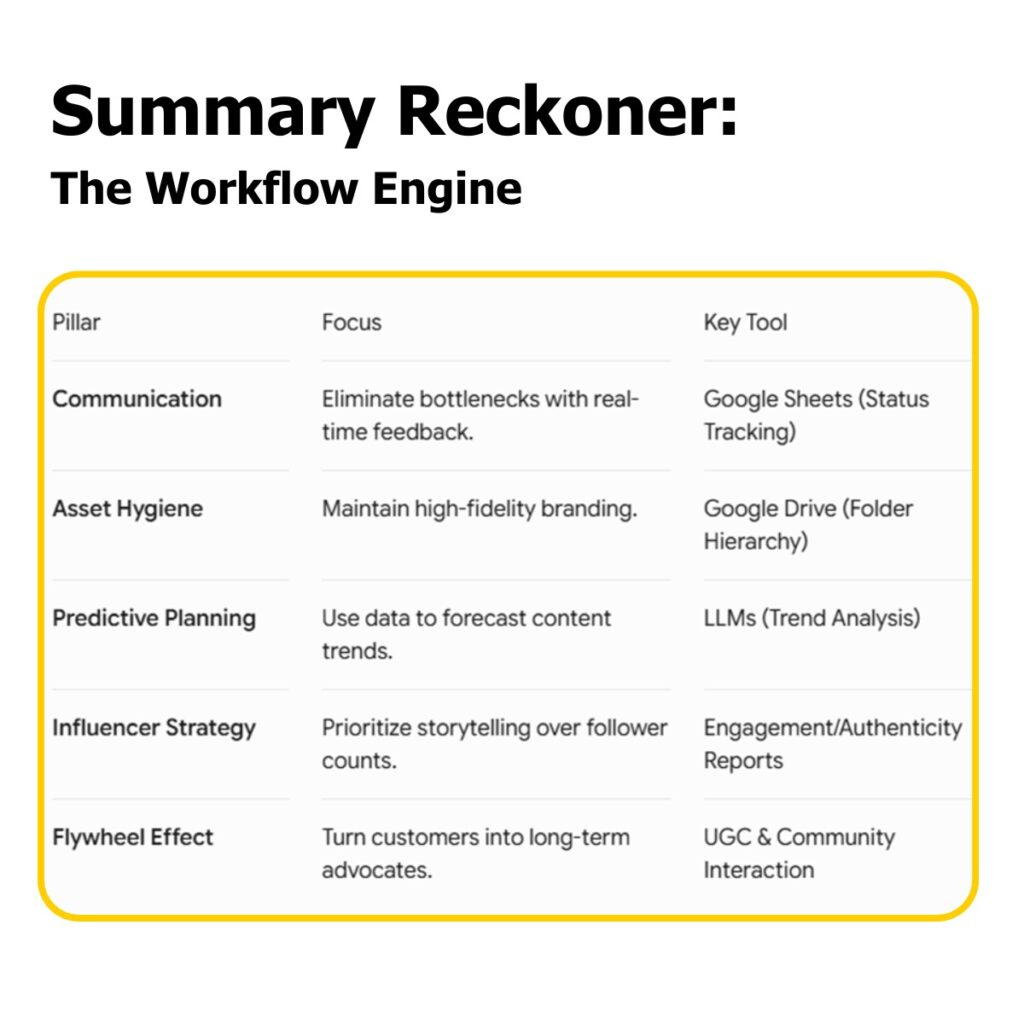
Managing cross-functional teams requires a unified social media marketing agency workflow. Google Sheets and Google Drive serve as the central nervous system for your operations. By moving away from email chains, you prevent version control issues.

  • Centralized Calendar:

    In your master Google Sheet, create columns for: Date, Platform, Content Pillar, Creative Brief, Status (Draft/Review/Approved), and Links to Assets. Planners input the strategy, designers link their high-fidelity files, and marketing managers use the “Status” column to provide feedback. This creates a vertical flow where no information is lost in a message thread.

  • Asset Management:

    Within Google Drive, establish a folder hierarchy: Client Name > Year > Month > Campaign Theme. Inside, separate folders into “Working Files” (PSD/AI) and “Exported Assets” (JPG/MP4). This ensures your designers aren’t searching for logos, and your managers always know where the final, approved content lives.

  • Approval Gateways:

    Use a specific “Pending Approval” column with a data validation dropdown menu. When the status changes to “Approved,” an automated notification can be set up via Google Apps Script (or simple manual alerts) to notify the social media manager that the asset is ready to be scheduled.

Pro-Tip: Convert the google sheet to table format and color-code the variables (e.g., Green for “Approved,” Red for “Revision Required”) to provide instant visual status updates to your entire team.

Predict & Prosper: Leveraging LLMs for Future-Proof Content

The future of any effective social media marketing agency workflow lies in predictive intelligence. Large Language Models (LLMs) can analyze industry data to forecast upcoming trends, allowing your social media marketing agency workflow to shift from reactive to proactive.

  • Trend Spotting:

    To do this, download your monthly analytics data or industry-specific reports (like sustainability trends in tea or healthcare) and upload them to your LLM. Ask it to “identify three emerging themes from this data for the next quarter.” This helps your team plan content that is timely and data-backed.

  • Content Forecasting:

    Use your LLM to act as a “virtual strategist.” Prompt it: “Given these successful posts from last quarter, suggest five new topics that build on this momentum.” This keeps your content cycle evolving rather than repeating the same themes.

  • Drafting at Scale:

    Instead of writing every caption from scratch, provide the LLM with your “Brand Voice Guide.” Ask it to draft captions based on your key messages. This allows your human team to focus on refining the tone and perfecting the strategy rather than staring at a blinking cursor. 

Pro-Tip: Create a dedicated “Brand Persona” document in your Drive and feed it into your LLM prompts to ensure every piece of generated content sounds authentic to your brand.

Storytellers, Not Just Influencers: Finding the Right Advocates

Choosing partners for your social media marketing agency workflow goes beyond vanity metrics. A data-centric approach must meet the art of storytelling to truly resonate with your audience.

  • Beyond the Follower Count:

    Shift from the “mid-tier” obsession to the “engagement-centric” model. Look for influencers with 1.5L to 1M followers who show high interaction in their comments. Analyze their content history to see if they reply to followers—this indicates a genuine community, not just a following.

  • The Fit Test:

    During the selection process, look at the content style. Does the influencer naturally incorporate products into their daily life through a story, or do they just hold products up for a photo? Prioritize those who can narrate how a product solves a problem.

  • Storytelling First:

    To facilitate this, your social media marketing agency workflow should include a “Collaboration Brief.” Instead of a script, provide the influencer with a “Problem-Solution” framework. Ask them to share their own experience with your product category, allowing their natural storytelling voice to shine through, which builds significantly more trust.

Pro-Tip: Request audience demographics and authenticity reports using tools like HypeAuditor to verify that you are engaging real people, not just bot-inflated accounts.

Visual Identity: Designing for Instant Brand Recognition

Brand recognition in a crowded feed requires a distinct visual signature. Your social media marketing agency workflow must prioritize consistency in color, theme, and design elements so that your brand is recognizable even without a logo.

  • Color Psychology:

    Decide on a signature brand color palette. If your client is a heritage tea brand, consider deep earth tones; if it’s a modern tech-driven healthcare client, choose cleaner, vibrant, or high-contrast tones. Once chosen, these colors must be used in every piece of content—from social cards to video overlays.

  • Signature Elements:

    Develop a “Brand Frame” or a consistent font style for typography overlays on images. When your audience sees a specific font or a consistent graphic border repeatedly, their brain creates a shortcut to identify your brand instantly.

  • Visual Continuity:

    Store these elements as “Templates” in a dedicated Google Drive folder. This way, any designer on your team—or even an LLM-assisted tool—can pull these assets to ensure that every post, reel, or graphic is instantly tied back to the brand’s visual identity.

Pro-Tip: Develop a “Brand Style Guide” folder in your Drive accessible to all designers, containing your approved hex codes, fonts, and asset templates.

The Flywheel Effect: Optimizing for Advocacy

To spin your brand’s flywheel faster, your social media marketing agency workflow must focus on converting audiences into advocates who do the marketing for you.

  • Attract & Engage:

    Your initial content should be educational or entertaining enough to stop the scroll. By analyzing which topics generate the most “shares” versus “likes,” you can identify which content pushes the flywheel.

  • Delight & Retain:

    Use your community management time to turn a customer’s comment into a conversation. When a user feels “seen” by a brand, they are more likely to return, which increases the algorithm’s preference for your content.

  • The Advocacy Loop:

    Actively encourage your audience to post about their own experiences. When a real customer shares a photo using your product, repost it. This creates a loop of social proof: New audiences see the genuine endorsement, they interact, they buy, and they eventually become advocates themselves, adding momentum to the flywheel.

Pro-Tip: Create a library of user-generated content (UGC) within your Drive; featuring your own customers builds significantly more trust than corporate-led messaging.

How are you currently managing the hand-off between your designers and the approval authorities for your client campaigns?

Enhancing Agency Efficiency: The Tejom Digital Approach

At Tejom Digital, we view ourselves as an extension of your marketing team, not just a service provider. We have refined our social media marketing agency workflow specifically to bridge the gap between creative design and corporate approval authorities, ensuring high-fidelity output with significantly faster turnaround times.

Bridging the Gap: Designers to Approvals

The primary friction point in most agencies is the “feedback loop” between creative teams and clients. We eliminate this by replacing fragmented email chains with a centralized Google Workspace environment.

  • The Shared Workspace: We establish a dedicated Drive folder for every client, partitioned into “Working,” “Review,” and “Final” assets. This ensures your marketing managers always have visibility into the current version, eliminating the confusion of “final_v2_final.jpg.”
  • Real-Time Collaboration: By using shared Google Sheets for content calendars, we allow your internal team to provide feedback directly on the copy or creative brief. This keeps the designer, planner, and approval authority on the same page, in real-time.
  • Quality Assurance: Tejom Digital’s design team is trained to work within established brand guidelines, which are stored in the same Drive environment. This ensures that every asset is “on-brand” before it even reaches your desk, reducing the number of revision rounds required.

Ready to Streamline Your Agency Workflow & Scale Your Brand?

Stop losing momentum to fragmented feedback loops and chaotic hand-offs. Partner with Tejom Digital to bring predictive AI strategy, seamless Google Workspace workflows, and high-converting creative execution to your business.

A 15-minute session?

Take the first step toward future-proof growth:

  • For a Direct Business Query: Call us at  99034 72194

  • For a Quick Consultation: WhatsApp our team at 79807 31010

FAQs

Q1. How does the flywheel model differ from a standard marketing funnel?

The traditional funnel is linear, ending at the sale; the flywheel is a circular model where every customer interaction is used to drive future growth, focusing on long-term relationships rather than one-time transactions.

Q2. What is “content atomization” and how does it help?

Atomization involves taking one “hero” asset and breaking it down into smaller, platform-specific pieces, which saves time, reduces production costs, and ensures your brand message remains consistent across all channels.

Q3. How can I measure the success of my agency’s flywheel?

Focus on metrics like repeat engagement, referral rates, and the volume of user-generated content (UGC), as these indicators show that your audience is actively participating in your brand’s growth.

Q4. Why should I bother with “brand advocate” identification?

Advocates act as a “force” that adds momentum to your flywheel, allowing you to reach new customers through trusted recommendations rather than just relying on paid ads, which are less sustainable.

Q5. Can I use AI to manage the flywheel’s complexity?

 Yes, use AI to identify topic clusters and sub-topics based on your best-performing content, ensuring your curation process remains data-driven and relevant to your audience’s evolving needs.

Q6. What happens if the flywheel stops spinning?

If momentum drops, you likely have “friction” in your process—this could be poor communication between your planners and designers, or a lack of delight in the post-purchase customer experience.

Q7. Should I re-share old content to keep the flywheel moving?

Absolutely. Repurposing high-performing assets (e.g., turning a successful video into a carousel) is a key part of the flywheel; it extends the value of your work and introduces winning ideas to new followers.

Q8. How do I prevent “content fatigue” in my agency?

By using batching and templates stored in your shared Drive, you reduce the “creative tax” on your team, allowing them to focus on high-level strategy instead of repetitive manual tasks.

Q9. Is a large budget required to start a flywheel?

No; the flywheel model is specifically designed to reduce long-term acquisition costs by focusing on organic growth and the compounding value of existing customers and advocates.

Q10. What is the biggest mistake agencies make with this model?

The biggest mistake is treating the flywheel as a one-off effort; it is a systematic approach that requires consistent “force” (content) and “friction removal” (clean processes) to be effective.

Q11. How does Tejom Digital structure its social media management retainer models?

Tejom Digital structures retainers as bespoke, data-driven partnerships that integrate directly into your internal team. Instead of one-size-fits-all packages, we conduct a deep analysis of your market dynamics and goals to build a scope that covers everything from AI-backed strategic planning to high-fidelity creative production. Our retainers are built on full transparency—utilizing shared Google Drive and Sheet environments—to ensure you have real-time visibility into strategy, execution, and performance reporting. By focusing on an agile, integrated social media marketing agency workflow, we provide the flexibility to scale and pivot your content strategy as your brand grows.

Q12. Why is Tejom Digital considered a top agency in Kolkata?

With close to a decade of experience, Tejom Digital combines award-winning design, data-backed strategy, and a commitment to transparency, making us a trusted partner for businesses that demand both prestige and performance. It was awarded top 10 Advertising Agency in Digital Space by Silicon India, a prominent Indian media company and technology news portal that publishes a monthly magazine focused on the technology, business, and startup ecosystems.

#SocialMediaMarketingAgencyWorkflow, #SocialMediaMarketingAgencyInKolkata, #KolkataBrands, #DigitalMarketingKolkata, #AgencyWorkflow, #MarketingAutomation, #LLMinMarketing, #ContentStrategy, #FlywheelMarketing, #BrandStrategy, #InfluencerMarketingIndia, #TejomDigital

Author: Anirban Guha

Anirban Guha is the founder and strategic mind behind Tejom Digital, an award winning agency defined by its ability to turn digital challenges into sustainable revenue streams. With a pedigree spanning powerhouse corporate roles and an MBA in Finance and Marketing, he brings the rigor of a corporate analyst to the creative freedom of a digital storyteller.