Tejom Digital Awarded top 10 Advertising Startup for 2022 by Silicon India - Start Up City
Tejom-Digital-Digital-Marketing-Agency- is an registered MSME

आ नो भद्राः क्रतवो यन्तु विश्वतः

Let noble thoughts come from all directions

50 / 100 SEO Score

7Ps vs 7Cs Digital Marketing Mix

Let’s cut through the corporate noise: if your brand is still pushing old-school, internally focused sales pitches, your audience has already tuned you out. Modern digital landscapes don’t just demand visibility; they demand absolute, uncompromised customer alignment. To win the market today, you must pivot from looking inward to thinking outward. This ready reckoner breaks down how to map the classic service framework onto a modern buyer-centric model using the ultimate strategic blueprint: the 7Ps vs 7Cs digital marketing mix.

7ps-vs-7cs-digital-marketing-mix

The Ultimate Growth Blueprint for Modern Brands

The digital shift isn’t just about shifting budgets from print to programmatic advertising; it’s an evolution of corporate perspective. For years, executive teams leaned on the classic service marketing mix—the 7Ps—to engineer their operational plans (Kumar Mishra, 2020). But in a marketplace ruled by hyper-informed enterprise buyers and conscious consumers, those 7Ps can feel a little self-obsessed.

Enter the customer-first ecosystem. By pivoting to a value-driven lens, we transform our framework from internal metrics to customer-centric realities (Kumar Mishra, 2020). Let’s break down how this matrix shifts to build a high-converting 7Ps vs 7Cs digital marketing mix.

 1. Product vs. Customer Value

  • The Old Paradigm (Product): What features are we building into our SaaS tool or premium service?
  • The Digital Remix (Customer Value): What real-world bottleneck are we solving for our client? Your product is only as good as the functional value it delivers to the end user (Dennis, 2025).

 2. Price vs. Cost to Satisfy

  • The Old Paradigm (Price): What is our retail price point or monthly subscription fee?
  • The Digital Remix (Cost to Satisfy): What is the total financial and emotional investment for the buyer? This includes implementation friction, training time, and integration hurdles (Dennis, 2025). Minimizing this broader cost structure is what actually secures long-term customer loyalty.

 3. Place vs. Convenience

  • The Old Paradigm (Place): Where do we host our digital storefront or manage our distribution channels?
  • The Digital Remix (Convenience): How effortlessly can a user buy, onboard, and engage with us on mobile, web, or chat? Omnichannel accessibility is non-negotiable for smooth service delivery.

 4. Promotion vs. Communication

  • The Old Paradigm (Promotion): How loudly can we push out display ads, cold emails, and sponsored content?
  • The Digital Remix (Communication): Are we building a helpful, two-way narrative? True engagement means listening to market sentiment, refining content value, and using interactive feedback loops to drive real conversions.

 5. People vs. Caring

  • The Old Paradigm (People): Do we have a trained sales team and customer support center?
  • The Digital Remix (Caring): Does our brand display genuine empathy? From intuitive UI pathways to responsive account management, showing real care turns standard transactions into long-term brand advocacy.

 6. Process vs. Coordination

  • The Old Paradigm (Process): What internal backend systems dictate our workflow?
  • The Digital Remix (Coordination): How seamless is the customer journey across our cross-functional departments? Silos are brand killers; your tech stack must coordinate perfectly to make the buyer’s experience effortless.

 7. Physical Evidence vs. Confirmation

  • The Old Paradigm (Physical Evidence): Do we have a clean website interface, slick digital decks, and polished corporate branding?
  • The Digital Remix (Confirmation): Do we provide undeniable trust signals? Case studies, security certifications, user reviews, and video testimonials serve as the ultimate social proof to confirm our brand authority.

Framework Comparison

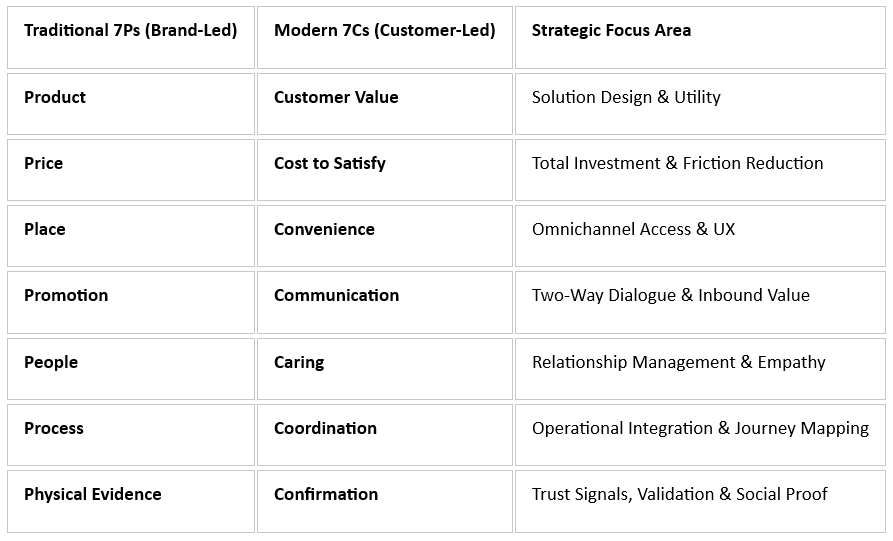
To help you quickly visualize this shift, here is how the two approaches stack up side-by-side in a modern 7Ps vs 7Cs digital marketing mix strategy:

Strategic Execution

To make the 7Ps vs 7Cs digital marketing mix work for your corporate growth, keep these three operational rules in mind:

  • Audit Before You Build: Map out your current 7Ps, then explicitly challenge your team to translate every single point into its corresponding 7Cs value metric.
  • Optimize the Financial Journey: Remember that your customer’s total cost is greater than your list price. Work to cut out onboarding delays and process friction.
  • Lead with Validation: In a digital world, trust is your currency. Back up your product claims with continuous social proof and clear confirmation signals.

Let’s make your marketing feel less like a pitch and more like a partnership.

Aligning your operations with what your buyers actually value is how you win the market. We do the heavy lifting so your brand can do the scaling.

A 15-minute session?

Take the first step toward future-proof growth:

  • For a Direct Business Query: Call us at  99034 72194

  • For a Quick Consultation: WhatsApp our team at 79807 31010

FAQs

Q1. What is the main difference in a 7Ps vs 7Cs digital marketing mix?

The classic 7Ps approach focuses heavily on internal operational controls (what the brand creates and controls), whereas the modern 7Cs model looks outward at customer experience, focusing on value, convenience, and direct communication.

Q2. How do the 7Ps translate into the 7Cs within a digital marketing mix?

Each internal operational element directly shifts into an external, customer-centric value point. Product evolves into Customer Value, Price becomes Cost, Place shifts to Convenience, Promotion transforms into Communication, People focus on Caring, Process demands Coordination, and Physical Evidence requires Confirmation.

Q3. Why is Customer Value more critical than Product features in this digital marketing mix?

Because modern enterprise buyers don’t buy features; they invest in solutions. Highlighting the specific utility and business value your product brings is what ultimately closes high-ticket deals.

Q4. What does Cost to Satisfy mean in a 7Ps vs 7Cs digital marketing mix?

Cost to Satisfy goes beyond the basic price tag. It covers the complete investment a client makes to use your solution, including setup time, team training curves, and operational changes.

Q5. How does Promotion evolve into Communication in a digital marketing mix?

Instead of pushing loud, one-way advertisements, the modern framework focuses on opening an active, two-way dialogue through inbound content, community building, and quick customer feedback.

Q6. Why is Convenience preferred over Place in digital channels?

In an online environment, geographic location matters much less than how easy it is to find, purchase, and use your services across web, mobile, and app platforms.

Q7. How do you measure Caring within the modern corporate marketing mix?

Caring is tracked through customer health scores, user retention rates, the empathy of your account management teams, and how quickly you resolve onboarding friction.

Q8. What role does Coordination play in optimizing the 7Ps vs 7Cs digital marketing mix?

Coordination ensures that your internal teams—from product development to marketing and sales—work together smoothly so the customer experiences zero friction.

Q9. What counts as Confirmation in a digital-first service framework?

Confirmation is any form of social proof that builds trust, including user reviews, third-party security audits, detailed case studies, and corporate video testimonials.

Q10. Can a business use both the 7Ps and 7Cs marketing models together?

Absolutely. Exceptional digital agencies use the 7Ps to manage internal operations and costs, while leading with the 7Cs to build customer-facing messaging and drive retention.

#7PsVs7CsDigitalMarketingMix #DigitalMarketingMix #MarketingFramework #CustomerCentricity #TejomInsights #TejomDigital #GrowthStrategy #MarketingStrategy #CorporateMarketing #DataDrivenMarketing #TejomDigital