

Tejom Digital Awarded top 10 Advertising Startup for 2022 by Silicon India - Start Up City
Tejom-Digital-Digital-Marketing-Agency- is an registered MSME

आ नो भद्राः क्रतवो यन्तु विश्वतः

Let noble thoughts come from all directions

Google AI Mode More Links 2026: What It Means for SEO

Five days after a widely-reported Chartbeat finding that publisher traffic from Google Search had fallen 40% year over year, Google published a blog post announcing five changes designed to show more — and more visible — links inside AI Mode and AI Overviews. This is Google’s own stated response to a problem the industry has been documenting for over a year, and it gives content and SEO teams something concrete to plan around.

This article explains exactly what Google announced on October 15, 2026, what remains untested or unconfirmed, and what a sensible response looks like for a business that depends on organic visibility.

What Google Actually Announced

In a post titled “More ways to connect with the web from Search,” Hema Budaraju, Google’s VP of Product Management, described five changes:

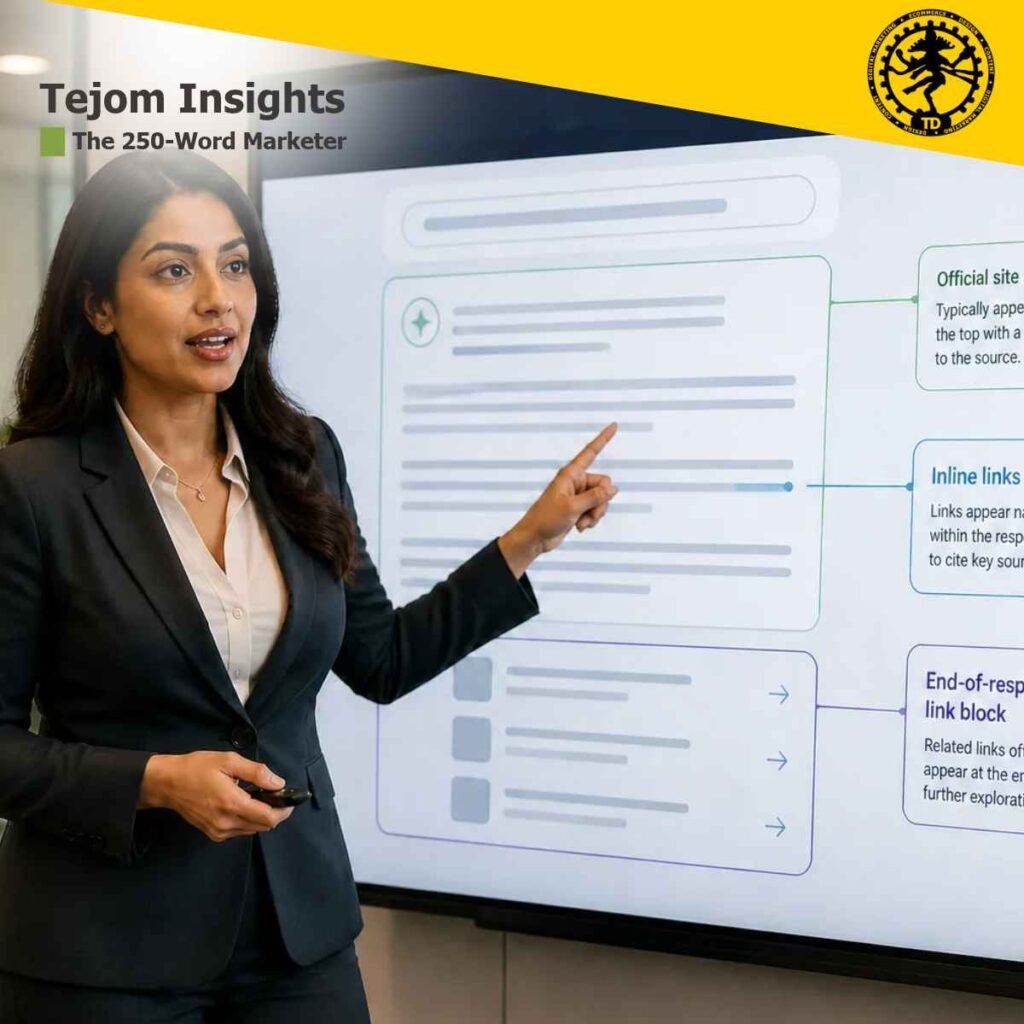
1. More, and higher-placed, inline links.

Google says it has already seen “continued and substantial increases” in inline links — links embedded directly in AI-generated text — and is launching further changes to show these links higher up in responses, more often.

2. A tested “official websites” section.

For tasks with one or two clear official destinations, Google is testing a dedicated section at the top of some answers, with an explanation of why each link is useful. This is explicitly a test, not a confirmed global feature.

3. Wider news carousels.

Carousels showing timely articles, which highlight a user’s chosen Preferred Sources, are rolling out to more locations and languages. Google names no specific new locations.

4. Bigger, more clickable end-of-response links.

Links shown at the end of some AI answers are getting image thumbnails and a more prominent design.

5. A test of clickable creator and publisher names.

Starting the week of October 12, 2026, creator and publisher names on video results inside AI Mode link through to their Search profiles — currently described as an early test, not a full rollout.

Alongside these five changes, Google disclosed one figure: the number of people using Preferred Sources — a setting that lets a person choose which publications they want to see favored in relevant results — has grown “more than 7x since the start of the year.” Google gives no January baseline and no current total, so this is a growth rate, not an absolute number.

Why This Matters, Not Just for Publishers

It is easy to read this as a story about news publishers specifically. It is not only that. Any business that depends on organic search visibility — a service business, a D2C brand, a B2B company publishing guides and comparisons — competes for the same limited space inside an AI-generated answer that these five changes are reshaping.

Three things make this relevant beyond the publishing industry:

  • The “official site” test rewards being the clear, singular answer for a specific task. A business with a well-structured, authoritative page for a specific product, service, or question is exactly what this test seems designed to surface.
  • Preferred Sources is a trust signal you can earn, not buy. A 7x growth in usage means more people are actively choosing which sources they trust enough to favor — which makes consistent quality and a clear brand identity more valuable, not less.
  • More prominent links do not mean more clicks are guaranteed. Google’s own post includes no data on whether these changes actually increase click-through rates; it describes design and placement changes, not measured outcomes.

What's Still Unconfirmed

In the interest of accuracy over confidence, several things Google has not said:

  • No specific rollout timeline, country list, or language list is given for the official-site test, the creator-name test, or the broader “higher up, more often” inline-link changes.
  • The 7x Preferred Sources growth figure has no disclosed starting baseline or current absolute total, so its real-world scale is unclear.
  • Google has published no click-through or traffic data showing these changes actually help websites recover visitors, despite the context of a widely reported 40% traffic decline.
  • It is not yet known whether the official-site section, if it exits testing, will apply broadly or remain limited to a narrow set of query types.

What To Do About It

1. Make your site unambiguous for the tasks it should win. If the “official site” section rewards clarity about which site is the real destination for a task, structured data, a clear “About” page, and consistent branding all help make that unambiguous to Google’s systems.

2. Treat Preferred Sources as a long-term trust goal, not a settings toggle you control directly. You cannot force a reader to mark your site as preferred; you earn it the same way you earn a bookmark or a follow — consistent, genuinely useful content over time.

3. Keep structured data and clean headings current, since Google explicitly said it’s testing section-style surfacing of specific destinations, which tends to reward content already organized clearly for extraction.

4. Watch for the official-site test in your own searches and your competitors’ categories, since Google has given no public list of where or when it’s visible.

Don’t treat this as a traffic-recovery guarantee. Plan content and SEO work around the fact that Google is testing changes, not that the changes have already reversed the traffic decline reported days earlier.

Key Takeaways

  • Google announced five changes to AI Mode and AI Overviews on October 15, 2026, aimed at showing more and more visible links to websites.
  • The changes include a tested “official websites” section, expanded news carousels, bigger end-of-response links, and a test of clickable creator and publisher names in AI Mode video results.
  • Preferred Sources usage has grown more than 7x since the start of 2026, per Google — though with no disclosed baseline or current total.
  • This follows, by five days, a widely reported Chartbeat finding of a 40% year-over-year decline in Google search traffic to publishers.
  • None of the five changes come with published click-through or traffic-recovery data; most are explicitly described as tests, not full rollouts.
  • The practical response is making your site unambiguous for specific tasks, keeping structured data current, and treating Preferred Sources as an earned trust signal rather than a setting to game.

Ready to Secure Your AI Search Visibility in 2026?

Navigating Google’s evolving AI Overviews and link placements requires a strategy built on clarity, entity authority, and structured data. Don’t let layout changes cost you organic traffic. Schedule a Consultation with Tejom Digital Today to audit your site for AI Search readiness and keep your brand ahead of the curve.

A 15-minute session?

Take the first step toward future-proof growth:

  • For a Direct Business Query: Call us at  99034 72194

  • For a Quick Consultation: WhatsApp our team at 79807 31010

FAQs

  1. What did Google announce on October 15, 2026?
    Five changes to AI Mode and AI Overviews aimed at showing more, and more prominent, links to websites: higher-placed inline links, a tested “official websites” section, wider news carousels, bigger end-of-response links, and a test of clickable creator/publisher names.
  2. Is this Google’s response to the reported 40% publisher traffic decline?
    Google’s post does not explicitly frame it that way, but it was published five days after a widely reported Chartbeat finding of a 40% year-over-year decline in search traffic to publishers, and addresses the same general concern — link visibility inside AI-generated answers.
  3. What is the “official websites” section?
    A tested display, for tasks with one or two clear official destinations, that places those links in a dedicated section at the top of some AI Mode and AI Overviews answers, with an explanation of why each is useful. Google describes it as a test, not a confirmed permanent feature.
  4. What is “Preferred Sources,” and why does the 7x figure matter?
    Preferred Sources is a setting that lets a person choose which publications they want favored in relevant results. Google says usage has grown more than 7x since the start of 2026, though it gives no starting baseline or current total, so the figure shows direction, not scale.
  5. Does this mean AI Overviews will send more traffic to websites now?
    That is not confirmed. Google’s post describes design and placement changes, not measured click-through or traffic outcomes. No data has been published showing an actual increase in clicks to external sites.
  6. Is the “official websites” section live everywhere now?
    No. Google explicitly describes it as being tested, with no stated rollout timeline, country list, or language list.
  7. What are the clickable creator and publisher names feature?
    A test, which Google says began the week of October 12, 2026, where creator and publisher names shown on video results inside AI Mode link to their Search profiles. It currently applies to AI Mode video results, not all AI Overviews content.
  8. How can my business benefit from these changes?
    By making your site clearly and unambiguously the right destination for the specific tasks or questions it answers, keeping structured data and headings well-organized, and building genuine reader trust that can translate into Preferred Sources selection over time.
  9. Can I pay to become a “Preferred Source” or appear in the official-site section?
    Nothing in Google’s announcement suggests either is a paid placement. Preferred Sources is described as a user-controlled setting, and the official-site test is described as algorithmic, based on being a task’s genuine official destination.
  10. Is there India-specific information in this announcement?
    No. Google’s post names no countries or languages for any of the five changes except describing the news-carousel expansion as reaching “more locations and languages globally,” without a list.
  11. How does this connect to earlier AI-search changes covered on this site?
    This is distinct from, and a direct follow-up to, the previously covered Chartbeat-sourced traffic-decline story (October 20, 2026) — that article reported the problem; this one reports Google’s own announced response to it, five days later.
  12. Should I change my content strategy immediately because of this?
    Treat this as useful directional evidence for an ongoing strategy, not a reason for an urgent pivot. Since most of the five changes are still being tested and no performance data exists yet, the sensible response is strengthening the fundamentals — clarity, structure, and trust — that these changes appear to reward.

#GoogleAIMode #AIOverviews #SEO #GEO #AEO #AISearch #ContentStrategy #DigitalMarketing #SearchTrends2026 #TejomDigital

Shopify AI Shopping Channels: What’s Auto-Enabled in Your Store

Shopify’s AI shopping channels — Meta’s Muse, Google’s AI Mode, Microsoft Copilot, and ChatGPT — are switched on by default for eligible stores, not opt-in. Here’s exactly what’s shared, what direct checkout means for your analytics, and what to audit before your festive sales traffic arrives.

Read More »

ChatGPT Image Generation Ads: What Marketers Should Know

OpenAI has started testing a new ad format inside ChatGPT: labeled display ads next to the images users generate. It’s US-only for now, but it signals where AI chat advertising is headed. Here’s what ChatGPT image generation ads actually involve, what’s confirmed, and what Indian marketers should watch before it reaches here.

Read More »

Google Ads Customer Retention Goals: What’s New in 2026

Google Ads customer retention goals have moved from beta to wide availability this month, with new Shopping support and a percentage-based value multiplier. Here’s what actually changed, what Google hasn’t confirmed yet, and how to use it to hold onto the festive-season buyers you’re about to acquire.

Read More »

AI Search Query Growth 2026: What It Means for Content Strategy

Google’s Q3 2026 earnings call revealed that year-over-year search query growth is the highest it has been in five years, fuelled by AI Mode and more conversational, multimodal searching. Here’s what this ai search query growth means for how Indian businesses should plan content and SEO for the months ahead.

Read More »

Cheap Agencies, Costly Mistakes: How Unlicensed Content Can Tank Your Brand

In an era where digital content moves at breakneck speed, cutting corners with budget agencies or unvetted freelancers can invite catastrophic legal liability. This ready reckoner breaks down how unlicensed stock photos, stolen vectors, and unverified media assets can result in hefty copyright penalties under Section 63 of the Indian Copyright Act, forced rebrands, and lasting reputational fallout.

Read More »