
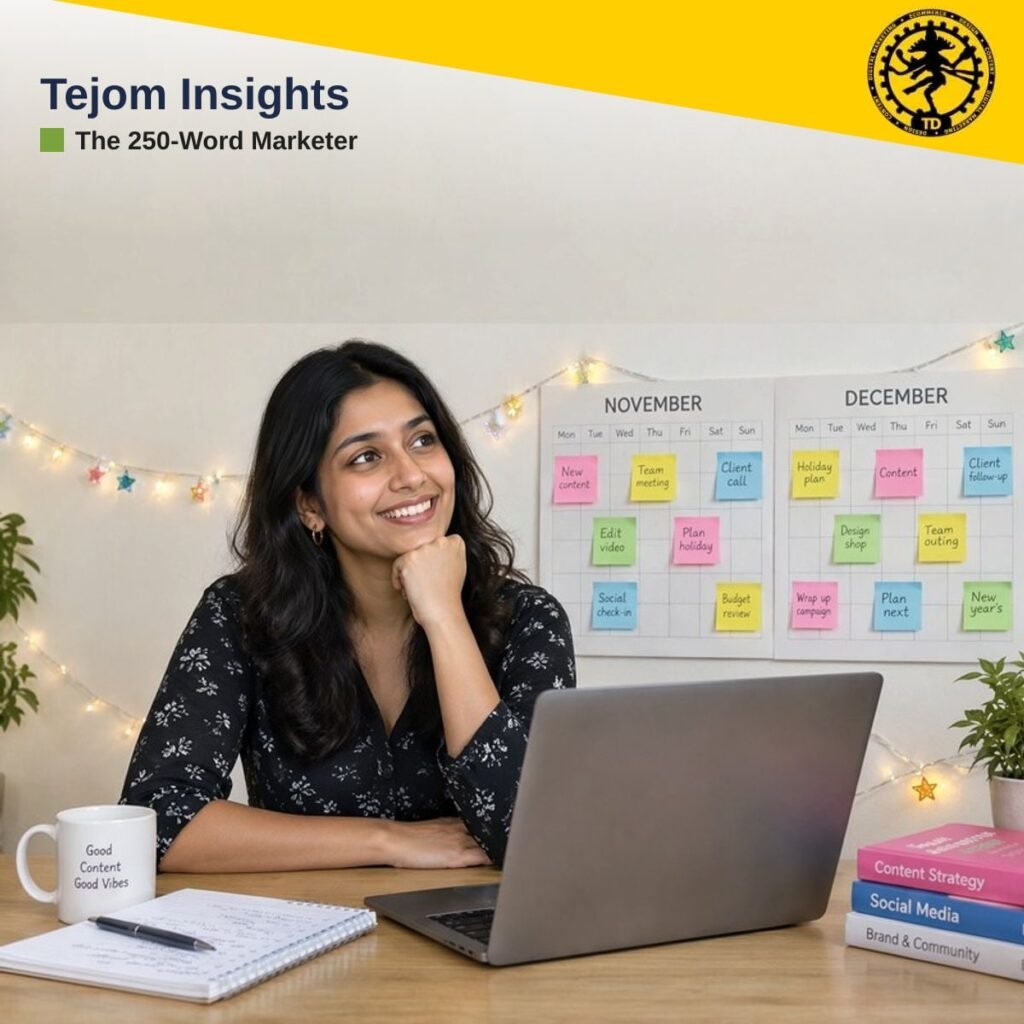
Occasion Marketing Calendar for Indian Brands: November 2026 to January 2027

Diwali is over, and many Indian brand calendars go quiet until Republic Day. That gap is an opportunity. The next ten weeks hold a run of occasions — some big shopping peaks, some quirky global days — where a sharp, relevant idea can earn attention that a regular post never would.

The catch is that most brands treat occasions as a posting obligation. A logo on a template, a hashtag, a generic greeting. Audiences scroll straight past. Here is an occasion marketing calendar for November 2026 to January 2027, with a simple test for which days are worth owning.

Occasion Marketing Calendar for Indian Brands: November 2026 to January 2027

First, a Test: Should Your Brand Show Up at All?

Not every moment deserves a response. Indian agencies themselves are relearning this, with industry coverage this year noting that brands are getting more selective about which cultural conversations they join. Before you add a date to the plan, ask three questions:

  1. Is there a real link? Can you connect the day to what your brand does, believes or sells in one honest sentence?
  2. Do you have something to say or do? An offer, a useful tip, a piece of data, a stunt or an act of service — not just a greeting.
  3. Can you make it on time and on brand? Late or sloppy occasion work is worse than none.

If the answer to any of these is no, skip the day and put the effort into one you can own. Occasions can absorb a meaningful share of spend; one media buyer quoted by Financial Express this year said top consumer brands in India often put 20% to 40% of their annual marketing budget into occasion-specific campaigns. That money deserves a filter.

November 2026

  • World Kindness Day — 13 November. Just gone, but worth noting for next year. Our idea: “The Great Client Compliment Drop” — brands publicly thanking the customers and partners who made their year.
  • World Toilet Day — 19 November. A UN observance about sanitation. Natural fit for FMCG hygiene brands, plumbing and building materials, real estate and civic-minded businesses. Our angle: “Flush the Fluff” — cut the filler from your marketing the way you’d clean up a messy feed.
  • Black Friday — 27 November. Now a real shopping peak in India. Unicommerce reported that Black Friday order volumes in 2025 grew 27% over 2024, led by healthy food, beauty and personal care and home categories. Retailers increasingly run the week, not just the day. Our angle for agencies and B2B brands: “Black-Hat Friday” — the marketing shortcuts that look cheap and cost you later.

December 2026

  • World Computer Literacy Day — 2 December. Fits edtech, telecom, banks pushing digital adoption and any brand with an app. Our angle: “Explain It to My Grandmother” — rewrite your product in words a first-time smartphone user would understand.
  • Universal Health Coverage Day — 12 December. Strong for hospitals, diagnostics, insurers and pharmacies. Our angle: “Vitamins, Not Placebos” — real health information instead of feel-good noise.
  • National Energy Conservation Day — 14 December. India’s own observance. Fits solar, appliances, EVs, paints and building materials. Our angle: “Dark Mode: Activated” — small switches that save real energy.
  • Christmas — 25 December, and Boxing Day — 26 December. Christmas is crowded; Boxing Day is less so and rewards retailers, D2C brands and services with a clear post-festive offer. Coca-Cola’s long-running Christmas work is the classic case study in owning a season through consistency.

January 2027

  • New Year — 1 January. A single post is not enough to own it. For small and mid-sized businesses, the stronger play is client advocacy: invite three happy customers to share what changed for them this year, and turn those stories into a January series.
  • Republic Day — 26 January and the run-up to tax-saving season sit just beyond this window. If they matter to your category, start planning in December.

For the full year, see our free 2027 occasion calendar.

How to Plan One Occasion Properly

  1. Start ten days out. Our Occasions hub lists each day in its Live section ten days before it happens, with a countdown, so there is time to brief, create and approve.
  2. Write one idea in one line. If you can’t, the occasion isn’t right for you.
  3. Build one landing page, not ten posts. A dedicated page — with the idea, something interactive or useful, and a clear next step — gives every post, reel and ad somewhere to send people.
  4. Promote it briefly and measurably. A short paid push, such as a three-day Meta campaign optimised for landing page views, is usually enough to test whether the idea lands.
  5. Keep it live. Don’t delete occasion pages after the day. Move them to an archive; they keep earning search traffic and show prospects your thinking.

What’s Still Unclear

There is very little independent, India-specific data on the return from occasion and moment marketing. Most of what’s published is campaign case studies and practitioner opinion, and industry voices note that moment-led work is harder to attribute than always-on activity. Measure every occasion against a simple goal — landing page visits, enquiries or sales — rather than likes.

Key Takeaways

  • The ten weeks after Diwali hold strong occasions: World Toilet Day (19 Nov), Black Friday (27 Nov), World Computer Literacy Day (2 Dec), UHC Day (12 Dec), National Energy Conservation Day (14 Dec), Christmas and Boxing Day, and New Year.
  • Black Friday is a real Indian shopping peak: order volumes grew 27% in 2025 according to Unicommerce.
  • Only show up when there is a real link, something to say or do, and time to do it well.
  • Plan each occasion ten days ahead around one idea and one landing page, then promote it briefly and measure it.
  • Keep occasion pages live in an archive instead of deleting them.

Sources

Want Your Next Three Occasions Planned?

Browse our Occasions hub for live ideas, or ask us to plan your brand’s next three occasions end to end.

A 15-minute session?

Take the first step toward future-proof growth:

FAQs

  1. What is occasion marketing?
    Occasion marketing means planning brand activity around specific dates — festivals, global observances or shopping peaks — with an idea that links the day to what the brand does or believes.
  2. What is the difference between occasion marketing and moment marketing?
    Occasion marketing is planned around known dates. Moment marketing reacts to unplanned events such as a viral trend or a sports win. Both work best when the link to the brand is genuine.
  3. Which occasions should Indian brands plan for in November and December 2026?
    Key dates include World Toilet Day (19 November), Black Friday (27 November), World Computer Literacy Day (2 December), Universal Health Coverage Day (12 December), National Energy Conservation Day (14 December), Christmas (25 December) and Boxing Day (26 December).
  4. Is Black Friday big in India?
    Yes, and growing. Unicommerce reported that Black Friday order volumes in India rose 27% in 2025 compared with 2024, led by healthy food, beauty and personal care, and home categories.
  5. How far in advance should a brand plan an occasion campaign?
    At least ten days for a focused idea with a landing page and a short paid push; several weeks for bigger festive campaigns.
  6. Should every brand post on every occasion?
    No. Only join an occasion when there is a real link to your brand, something useful to say or do, and enough time to execute it well.
  7. How do I measure occasion marketing?
    Set one simple goal per occasion, such as landing page views, enquiries or sales, and track it with UTM links and analytics rather than relying on likes.
  8. Does Tejom Digital plan occasion campaigns?
    Yes. Tejom Digital plans and executes occasion pages and campaigns. See the Occasions hub at tejomdigital.com/occasions.

#OccasionMarketing #MomentMarketing #MarketingCalendar #BlackFridayIndia #WorldToiletDay #FestiveMarketing #ContentPlanning #MarketingIndia #TejomInsights #TejomDigital

Is AI Search Visibility Worth It? What 3 New Studies Found
The 250-Word Marketer
Naina Adhikari

Is AI Search Visibility Worth It? What 3 New Studies Found

Three independent 2026 studies measured real website traffic and conversions from ChatGPT, Gemini, and other AI assistants against Google organic search — and found AI assistants send a small fraction of the traffic, though the visitors they do send often convert differently. Here’s what the data actually shows, what it doesn’t prove, and how to use it to plan your 2027 marketing budget.

Read More »