

Tejom Digital Awarded top 10 Advertising Startup for 2022 by Silicon India - Start Up City
Tejom-Digital-Digital-Marketing-Agency- is an registered MSME

आ नो भद्राः क्रतवो यन्तु विश्वतः

Let noble thoughts come from all directions

Shopify AI Shopping Channels: What’s Auto-Enabled in Your Store

Most Shopify merchants did not turn on AI shopping channels. Shopify turned them on for merchants, by default, and most store owners have likely never visited the settings page where this happened.

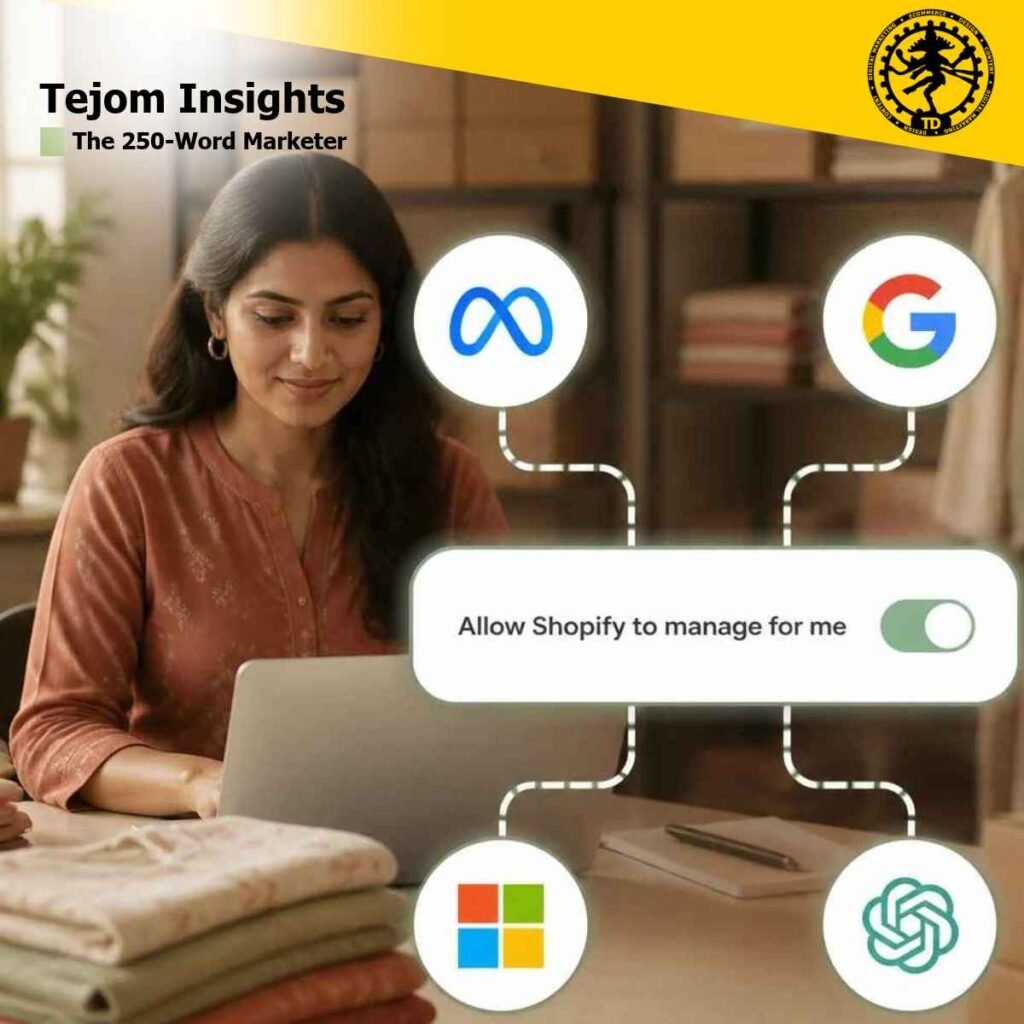
Since May 2026, Shopify has run a dedicated “Agentic Storefronts” page inside its admin, and a master setting called “Allow Shopify to manage for me” sits at the top of it, switched on for eligible stores. When Meta launched its Muse AI shopping agent on September 8, 2026, eligible Shopify stores were automatically added to it — no merchant had to opt in. The same default applies to Google’s AI Mode and Gemini, Microsoft Copilot, and ChatGPT, plus a broader “Other channels” category covering experimental third-party shopping agents.

With Diwali 12 days away and festive traffic about to surge, this is the moment to understand exactly what this default setting does, and to decide deliberately whether to keep it, adjust it, or turn parts of it off — rather than discovering the consequences in your sales reports after the fact.

What "Auto-Enrolled" Actually Means

According to Shopify’s own Help Center documentation, reviewed in a detailed October 2, 2026 walkthrough by website-optimisation consultant Slobodan Manic (published on his own site, No Hacks, and syndicated to Search Engine Journal), the mechanics work like this:

  • Product data sharing.

    Most AI channels — including ChatGPT, Copilot, and Meta’s Muse — read your product catalog through Shopify Catalog. Google instead reads from your connected Google Merchant Center account.
  • Direct checkout.

    On Meta (for stores selling in the US, Canada, or Mexico), Google’s AI Mode and Gemini (US stores with Merchant Center), and Microsoft Copilot (US stores), a shopper can complete a purchase inside the chat app itself, without ever landing on your store. ChatGPT is the exception — it redirects shoppers to your own checkout rather than processing payment inside the chat.
  • New channels, added automatically.

    Shopify first opted eligible merchants in back in January 2026, and the “auto-enroll in new agentic storefronts channels” behavior means any future AI shopping channel Shopify adds will include your store by default too, unless you’ve already turned that specific switch off.

The Part That Affects Your Numbers: Analytics

This is the detail most likely to cause real confusion during a high-traffic sales period. When a purchase completes inside a chat app through direct checkout, your store’s own tracking code does not run. That means Google Analytics and any custom pixels you’ve installed will not fire for purchases completed inside Google’s or Microsoft’s AI experiences, and third-party pixels will not fire inside Meta’s checkout either. Shopify does still record these orders in your Shopify admin — they are not lost — but they will not show up the way your team is used to seeing them in ad-platform dashboards or GA4 reports.

Practically, this means a brand running festive-season paid campaigns could see sales happen through an AI shopping channel while its performance-marketing dashboards show no credit for them at all, distorting return-on-ad-spend calculations right when budget decisions matter most.

What You Can and Can't Control

Shopify does give merchants real control, once you know where to look:

  1. Turn off “Allow Shopify to manage for me” in Sales channels > Agentic. This reveals separate, individual switches underneath it.
  2. Control catalog access per channel — you can allow a channel to see your product data without enabling direct checkout for it, or vice versa.
  3. Turn off “auto-enroll in new channels” specifically, which keeps your current setup but stops you from being silently added to whatever Shopify launches next.
  4. Hide a single product from all AI channels by marking it unlisted — though this also removes that product from your sitemap, organic search indexing, and your own store’s search, a trade-off worth weighing carefully rather than using casually.
  5. Expect a delay. Shopify’s own documentation notes that turning off catalog sharing can take up to seven days to fully stop data from flowing to a channel.

What's Still Genuinely Unclear

In the interest of a straight answer rather than overstating certainty:

  • Shopify has not published independent numbers on how many purchases AI shopping agents actually complete inside chat apps. The company has reported that AI-referred sessions grew 197% year-over-year in its second quarter, but a session is a visit, not a completed purchase, and this article does not conflate the two.
  • It is not stated whether Shopify’s own bot-filtering applies to the traffic and sales figures shown on the Agentic Storefronts admin page itself, so those numbers are worth treating with some caution.
  • No platform currently charges merchants a fee for sales completed through these AI channels, but Meta’s Mark Zuckerberg has said Meta expects to eventually take a small percentage of Muse transactions. No similar statement has been found from Google or Microsoft.
  • Separately, Bloomberg has reported that Amazon began blocking Meta’s Muse from accessing Amazon listings on September 20, 2026 — a reminder that not every retailer is treating AI shopping agents the same way, and that this is a genuinely unsettled area of e-commerce policy.

A Practical Pre-Diwali Checklist

  1. Open Sales channels > Agentic in your Shopify admin today and see exactly which channels and settings are currently active for your store.
  2. Decide deliberately — don’t just leave the default — whether direct checkout and catalog sharing make sense for your brand this festive season.
  3. If you keep AI channels active, set up a monthly habit of filtering your Shopify orders list by sales channel, so you can see what these channels are actually selling, separate from what shows in GA4 or ad dashboards.
  4. Brief your performance-marketing team now that AI-channel sales may not appear in standard attribution reports, so festive-season ROAS numbers aren’t misread.
  5. Revisit this setting again in the new year as Shopify adds further channels, rather than assuming today’s configuration is permanent.

Key Takeaways

  • Shopify auto-enrolls eligible stores into AI shopping channels — Meta’s Muse, Google’s AI Mode and Gemini, Microsoft Copilot, and ChatGPT — through a default-on setting most merchants have never reviewed.
  • Direct in-chat checkout (available for Meta, Google, and Copilot, but not ChatGPT) means purchases can complete without your store’s own tracking code firing, creating a real analytics blind spot.
  • Shopify gives merchants granular control — catalog access, auto-enroll behavior, and direct checkout can each be adjusted per channel — but the defaults favor broad participation.
  • No independent data exists yet on how many purchases these AI agents actually complete, and Shopify’s own reported growth figures measure referral sessions, not confirmed sales.
  • Review your Agentic Storefronts settings before festive traffic arrives, and brief your team that AI-channel sales may not show up in standard ad-platform attribution.

Ready to Audit Your Store's AI Settings?

Don’t let automated settings distort your festive season analytics or leave your team guessing where your sales are coming from.

Take control of your Shopify store’s agentic channels today:

  • Log into your Shopify admin and navigate to Sales channels > Agentic to inspect what’s currently turned on for your brand.

  • Connect with Tejom Digital if you want expert guidance on optimizing your D2C ecommerce strategy, structuring your festive campaign attribution, or navigating the evolving landscape of AI shopping agents.

A 15-minute session?

Take the first step toward future-proof growth:

  • For a Direct Business Query: Call us at  99034 72194

  • For a Quick Consultation: WhatsApp our team at 79807 31010

FAQs

  1. Did I opt in to Shopify’s AI shopping channels?
    Most likely not deliberately. Shopify switched on a default setting, “Allow Shopify to manage for me,” that auto-enrolls eligible stores, first opting merchants in back in January 2026.
  2. Which AI shopping channels are included?
    Meta’s Muse, Google’s AI Mode and Gemini, Microsoft Copilot, and ChatGPT, plus a broader “Other channels” category for experimental third-party shopping agents.
  3. Can a customer actually buy inside the chat app?
    Yes, for Meta (US, Canada, Mexico stores), Google’s AI Mode and Gemini (US stores with Merchant Center), and Microsoft Copilot (US stores). ChatGPT instead redirects shoppers to your own store’s checkout.
  4. Will I see these sales in Google Analytics?
    Not reliably. When a purchase completes through in-chat direct checkout, your store’s tracking code doesn’t run, so standard analytics and pixel tracking will miss it. The order still appears in your Shopify admin.
  5. How do I turn this off?
    Go to Sales channels > Agentic in your Shopify admin and turn off “Allow Shopify to manage for me.” This reveals separate controls for catalog access, auto-enrollment, and direct checkout that you can adjust individually.
  6. If I turn off catalog sharing, does it stop immediately?
    No. Shopify’s own documentation says it can take up to seven days for shared catalog data to fully stop flowing to a channel.
  7. Can I hide just one product instead of the whole store?
    Yes, by marking it unlisted — but this also removes it from your sitemap, organic search indexing, and your own store’s search, so use it deliberately rather than casually.
  8. Does Shopify or Meta charge a fee for these sales?
    Not currently. Meta’s Mark Zuckerberg has said Meta expects to eventually take a small percentage of Muse transactions, but no fee is active yet, and no similar statement has been found from Google or Microsoft.
  9. Is this available for stores selling in India?
    Direct in-chat checkout is currently limited to US, Canadian, and Mexican stores depending on the channel. Shopify Catalog data sharing (product visibility to AI channels) applies more broadly to eligible stores, which is why this is worth reviewing even before checkout-level features reach India.
  10. How big is this trend, really?
    Shopify has reported AI-referred sessions grew 197% year-over-year in a recent quarter, but this measures visits, not confirmed purchases, and no independent, verified sales figure has been published.
  11. Is every retailer embracing AI shopping agents the same way?
    No. Bloomberg has reported that Amazon began blocking Meta’s Muse from its own listings on September 20, 2026, showing this is still an unsettled area of e-commerce policy, not a uniform industry standard.
  12. What should I actually do before Diwali?
    Check your current Agentic Storefronts settings today, decide deliberately whether to keep them as-is, and make sure your performance-marketing team knows that AI-channel sales may not appear in standard attribution reports this festive season.

#ShopifyAI #AgenticCommerce #Ecommerce #D2C #AIShoppingAgents #MetaMuse #DigitalMarketing #FestiveSeason2026 #ShopifyMerchants #TejomDigital

Google AI Mode More Links 2026: What It Means for SEO

Google just announced five changes to show more, and more prominent, links inside AI Mode and AI Overviews. This Google AI Mode more links 2026 update includes a tested “official site” section and 7x growth in Preferred Sources use. Here’s what changed, what’s still unconfirmed, and what it means for your content strategy.

Read More »

ChatGPT Image Generation Ads: What Marketers Should Know

OpenAI has started testing a new ad format inside ChatGPT: labeled display ads next to the images users generate. It’s US-only for now, but it signals where AI chat advertising is headed. Here’s what ChatGPT image generation ads actually involve, what’s confirmed, and what Indian marketers should watch before it reaches here.

Read More »

Google Ads Customer Retention Goals: What’s New in 2026

Google Ads customer retention goals have moved from beta to wide availability this month, with new Shopping support and a percentage-based value multiplier. Here’s what actually changed, what Google hasn’t confirmed yet, and how to use it to hold onto the festive-season buyers you’re about to acquire.

Read More »

AI Search Query Growth 2026: What It Means for Content Strategy

Google’s Q3 2026 earnings call revealed that year-over-year search query growth is the highest it has been in five years, fuelled by AI Mode and more conversational, multimodal searching. Here’s what this ai search query growth means for how Indian businesses should plan content and SEO for the months ahead.

Read More »

Cheap Agencies, Costly Mistakes: How Unlicensed Content Can Tank Your Brand

In an era where digital content moves at breakneck speed, cutting corners with budget agencies or unvetted freelancers can invite catastrophic legal liability. This ready reckoner breaks down how unlicensed stock photos, stolen vectors, and unverified media assets can result in hefty copyright penalties under Section 63 of the Indian Copyright Act, forced rebrands, and lasting reputational fallout.

Read More »