
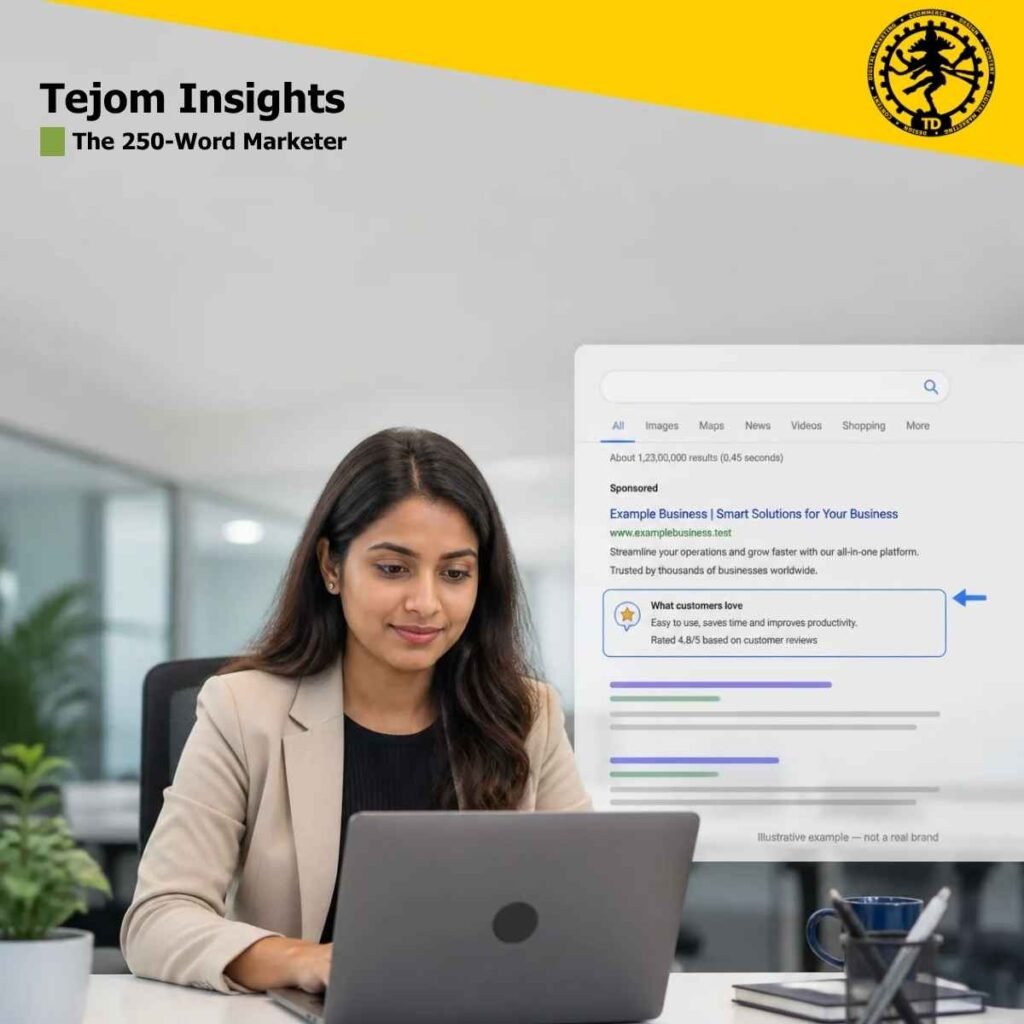

Google Ads Review Summaries: What “What Customers Love” Means for Your Business

Your online reviews just started doing a new job. Google has confirmed that Search ads can now carry a short, AI-written summary of what customers say they love about your business — pulled directly from your existing reviews, written by Google’s AI, and shown without asking you first. If you run Google Search ads in India, this may already be live on your account.
This is not a rumor or an experiment buried in a testing forum. As of late October 2026, Google has documented the feature on its own Ads Help Center, confirming it is live in four markets: the United States, the United Kingdom, Australia, and India.

Google Ads Review Summaries: What "What Customers Love" Means for Your Business

What exactly is live

Here is what Google has confirmed, based on its own Help Center page and independent reporting:

  • What it is: A short line of AI-generated text, labeled as a review summary, that appears inside a Search ad on Google.com.
  • Where it shows: All ad positions, on all supported devices, for Search campaigns — not Shopping, Display, or Performance Max.
  • How it’s written: Google’s AI reads a business’s existing online reviews and writes a positive-only summary. Negative themes are not included.
  • Who decides when it shows: Google, not the advertiser. Google says it shows summaries only when its systems predict doing so will improve ad performance.
  • Can you edit it? No. The text is generated by Google and cannot be rewritten by the advertiser.
  • Can you opt out? This is genuinely unclear. Google’s help page does not describe an opt-out option, and it does not say whether existing account-level “automated assets” controls apply to review summaries specifically. Treat this as unconfirmed rather than assuming either answer.
  • What’s excluded: Google excludes sensitive categories, such as pharmaceuticals, from the feature.

How we got here

This did not appear overnight. In early September 2026, a tester spotted an early version of this — a label reading “What customers love,” marked “AI-generated from the store rating reviews” — while browsing Search results. At that point, it looked like an isolated test. By late October 2026, Google had moved it from an unannounced test to a documented, named feature on its own Help Center, across four English-language markets including India. That shift — from spotted-in-the-wild to formally documented — is usually a sign a feature is past the experimental stage and worth planning around now, not waiting on.

Why this matters more than it looks

For years, the advice to businesses has been: your online reviews matter for trust and for local search rankings. That advice just got a new, sharper edge. Your reviews can now appear, verbatim in spirit if not in exact wording, inside the paid ad you are spending money on. A thin, outdated, or lukewarm review profile doesn’t just hurt your Google Business Profile star rating anymore — it may mean Google’s AI has little positive material to draw from when deciding whether to enhance your Search ad at all.
This arrives two weeks before Diwali 2026 (November 8), when comparison shopping and local search volume are at their highest point of the year in India. A shopper comparing three similar businesses in a Search results page may now see one ad carrying a warm, AI-written endorsement and two that don’t — not because of bid strategy, but because of review volume and sentiment.

What you can't control, and what you still can

You cannot edit the generated text, and there is no confirmed way to switch the feature off. That is the uncomfortable part. But the input Google’s AI is reading from — your actual body of reviews — is something you can still directly influence, the same way you always could.

A practical checklist for this week

1. Check whether it’s live on your account. Review your current Search ads on Google.com and look for a review-summary line. Staged rollouts can mean it shows for some advertisers and queries before others.

2. Audit your review volume and recency. If your Google reviews are old, sparse, or skew negative, this is now a paid-search issue, not just a reputation one.

3. Build a genuine review-collection habit, not a one-time push. Ask satisfied customers directly, through receipts, follow-up messages, or in person — never through fake or incentivized reviews, which risk account and policy violations.

4. Don’t panic-edit your ad copy to compensate. The review summary is additive to your existing ad text, not a replacement for a clear headline and offer.

5. Watch for an opt-out setting. None is documented today. If Google adds one later, it will likely sit inside automated-assets account settings — check there periodically.

6. Ask your agency or account manager to confirm current behaviour on your account specifically. Staged, market-by-market rollouts are common, and your account’s exact state may differ from what’s documented generally.

Key Takeaways

  • Google has confirmed, on its own Help Center, that AI-written “review summaries” now appear in Search ads in India, the US, UK, and Australia.
  • The text is generated from your existing reviews, cannot be edited by the advertiser, and has no confirmed opt-out.
  • This moves review management from a reputation and local-SEO concern into a direct paid-search concern.
  • It arrives two weeks before Diwali 2026, during India’s highest-intent comparison-shopping period.
  • The one lever still fully in your control is the quality and volume of your genuine customer reviews.

Don't Let Outdated Reviews Hurt Your Search Ads.

Google’s AI is already writing review summaries for your ads—make sure it has positive feedback to highlight. Audit your review profile today and start turning satisfied customers into your best ad copy.

A 15-minute session?

Take the first step toward future-proof growth:

  • For a Direct Business Query: Call us at  99034 72194

  • For a Quick Consultation: WhatsApp our team at 79807 31010

FAQs

  1. What is a Google Ads review summary?
    A short, AI-generated line of text that Google can add to a Search ad, written from a business’s existing online reviews, highlighting positive themes.
  2. Is this feature live in India?
    Yes. Google’s own Help Center documentation, reported by PPC Land on October 25, 2026, names India as one of four confirmed markets, alongside the US, UK, and Australia.
  3. Can I turn this feature off?
    This is unconfirmed. Google’s help documentation does not describe an opt-out, and no independent source has confirmed one exists. Ask your account team directly and check automated-assets settings.
  4. Can I edit what the AI-generated summary says?
    No. The text is generated and controlled by Google, not the advertiser.
  5. Which campaign types does this apply to?
    Search campaigns only, as documented by Google. It does not apply to Shopping, Display, or Performance Max campaigns.
  6. Does this always show on my ads?
    No. Google says it only shows a summary when its systems predict it will improve ad performance, which implies not every advertiser or every ad will display one.
  7. What if my business has very few or no online reviews?
    Google’s documentation doesn’t state a minimum review count required. It is reasonable to expect that a thin review base gives the AI less positive material to summarise, which is itself a good reason to build a stronger review profile regardless.
  8. Are negative reviews reflected in the summary?
    No. Google has confirmed the summaries are positive-only.
  9. Is this the same as the AI Mode or AI Overviews ad formats covered elsewhere?
    No. Review summaries appear inside standard Search ads on Google.com. AI Mode ad formats, such as Conversational Discovery ads, are a separate, distinct product built for Google’s AI Mode conversational search experience.
  10. Which business categories are excluded?
    Google has confirmed sensitive categories, such as pharmaceuticals, are excluded from the feature.
  11. When did this actually become confirmed, rather than just a spotted test?
    A tester first spotted an early version around September 1, 2026. Google formally documented the feature on its Help Center by October 24–25, 2026, which is when it moved from an unconfirmed sighting to a documented, named feature.
  12. What should I do this week if I run Google Search ads in India?
    Check whether the feature is visible on your live ads, audit your current review volume and recency, and start or strengthen a genuine, policy-compliant review-collection process before Diwali’s peak search period.

#GoogleAds #SearchAds #AIAdvertising #ReputationManagement #DigitalMarketingIndia #PPC #MarTech #GoogleAdsIndia #PerformanceMarketing #TejomDigital

Is AI Search Visibility Worth It? What 3 New Studies Found
The 250-Word Marketer
Naina Adhikari

Is AI Search Visibility Worth It? What 3 New Studies Found

Three independent 2026 studies measured real website traffic and conversions from ChatGPT, Gemini, and other AI assistants against Google organic search — and found AI assistants send a small fraction of the traffic, though the visitors they do send often convert differently. Here’s what the data actually shows, what it doesn’t prove, and how to use it to plan your 2027 marketing budget.

Read More »