



Tejom Digital Awarded top 10 Advertising Startup for 2022 by Silicon India - Start Up City
Tejom-Digital-Digital-Marketing-Agency- is an registered MSME

आ नो भद्राः क्रतवो यन्तु विश्वतः

Let noble thoughts come from all directions

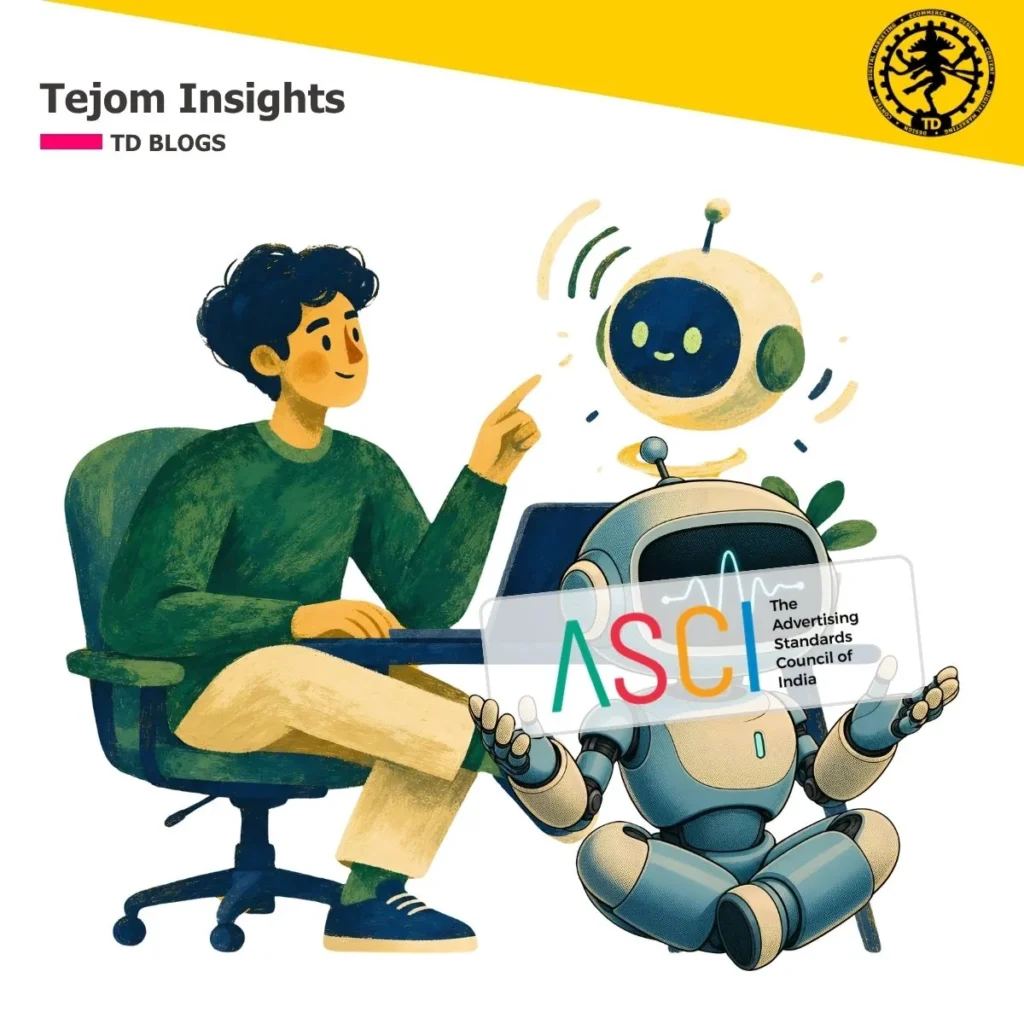
ASCI’s Draft AI Content Labelling Guidelines: What Advertisers Need to Know Before Festive Campaigns

AI-generated and AI-enhanced advertising creative is no longer an experiment — it is part of how many Indian brands now produce festive-season campaigns at scale. Before that production ramps up further ahead of Durga Puja and Diwali, advertisers should know that India’s own advertising self-regulatory body has a specific proposal on the table for how this content gets disclosed to consumers.

The Advertising Standards Council of India (ASCI) published draft “Guidelines for Responsible Labelling of AI-Generated Content in Advertising” on May 12, 2026. The guidelines are aligned with India’s Information Technology (Intermediary Guidelines and Digital Media Ethics Code) Amendment Rules, 2026, which were themselves amended on February 10, 2026. ASCI’s public comment window on the draft closed June 13, 2026.

As of this writing, ASCI has not published a finalized version of these guidelines, and no confirmed effective date is publicly available. This article explains exactly what the draft proposes, its current status, and what a reasonably cautious advertiser should do in the meantime — without claiming the rules are already in force.

ASCIs Draft AI Content Labelling Guidelines What Advertisers Need to Know Before Festive Campaigns

What ASCI's Draft Guidelines Actually Propose

ASCI’s draft takes what it calls a “risk-based approach, focusing on consumer outcomes rather than regulating the technology itself.” Rather than requiring a label on every piece of content that touched an AI tool, the draft sorts AI use in advertising into three tiers.

High risk (prohibited, regardless of labelling):

Content that stays outside ASCI’s code even if disclosed. The draft names deepfakes, fabricated endorsements, unauthorised use of a real person’s likeness, exaggerated or misleading visual claims, and using AI to generate fictional authority figures with identifiable real-world cues (for example, a fake doctor or expert persona).

Medium risk (labelling required):

Content where AI materially influences a consumer’s decision. The draft specifically calls out virtual influencers, synthetic product demonstrations, realistic AI-generated settings, and AI-driven paid or sponsored product suggestions — the last of which the draft says must carry a “sponsored by” label in addition to any AI disclosure. Suggested label language includes phrases like “Audio/Video created using AI” or “Audio/Video enhanced using AI.”

Low risk (no labelling needed):

Minor edits, decorative backgrounds, fantastical or clearly unrealistic elements, and administrative uses of AI that don’t materially affect a consumer’s purchase decision.

Why This Is a Different Question from Google's AI Labeling Feature

This project covered Google’s own AI labeling feature for Google Ads, Display & Video 360, Campaign Manager 360, Merchant Center, and Ads Editor creative in a separate article. That feature is an opt-in disclosure tool inside one advertising platform, and Google itself states it “doesn’t guarantee compliance with specific regulations.”

ASCI’s draft is a different kind of document. It is India’s own advertising self-regulatory body proposing rules that would apply across all media — television, print, out-of-home, and every digital platform, not just Google’s ad products. If finalized, it would function as an industry-wide reference point for what “adequate AI disclosure” means in India, the kind of standard that Google’s own tool explicitly says it cannot guarantee on its own. Brands running AI-assisted creative across multiple channels need to think about both: platform-level tools that help disclose AI use, and the broader industry standard ASCI is trying to set for when disclosure is expected at all.

What Advertisers Should Actually Do Right Now

Since the guidelines remain in draft form, nothing here is a legal requirement yet. That said, three practical steps make sense regardless of the eventual finalization date:

  1. Inventory your festive creative pipeline. Identify which upcoming assets use AI-generated visuals, AI voice or video enhancement, virtual influencers, or AI-driven product demonstrations. You cannot assess risk tier for content you haven’t catalogued.
  2. Map each asset against ASCI’s three-tier framework. Even informally, sorting planned creative into high/medium/low risk, using the draft’s own examples, gives your team and your legal counsel a head start rather than a scramble if and when guidelines are finalized.
  3. Build a lightweight labelling habit for medium-risk content now. Adding a simple, honest disclosure like “created using AI” or “enhanced using AI” to synthetic product demos or virtual-influencer content costs little and pre-positions your festive campaigns for whatever the final rules require.

What Remains Genuinely Uncertain

To be transparent about the limits of what’s knowable today: ASCI has not announced a finalization date, and this article does not assume one. Whether the final guidelines will match the draft’s three-tier structure exactly, whether an effective date will fall before or after this year’s festive season, and how enforcement will actually work in practice are all open questions. Treat any specific finalization date you encounter elsewhere with the same caution this article applies to itself, unless it cites ASCI directly.

Key Takeaways


  • ASCI published draft AI content labelling guidelines for advertising on May 12, 2026; the public comment period closed June 13, 2026, with no finalized version or effective date published as of this writing.
  • The draft uses a three-tier risk system: high risk (prohibited outright), medium risk (labelling required), and low risk (no labelling needed).
  • Virtual influencers, synthetic product demonstrations, and AI-driven sponsored product suggestions fall into the medium-risk, labelling-required category in the draft.
  • This is a separate, broader question from any single platform’s AI labeling tool — ASCI’s guidelines, if finalized, would apply across all media and platforms.
  • Cataloguing AI-assisted festive creative now and applying simple, honest labels to medium-risk content is a reasonable step regardless of the final rules’ exact timing.

Is your festive ad creative ready for India's new AI-disclosure rules?

ASCI has a draft proposal that could change how virtual influencers, AI product demos, and AI-enhanced videos need to be labelled. Here’s what it says, what’s still uncertain, and what to do now.

A 15-minute session?

Take the first step toward future-proof growth:

  • For a Direct Business Query: Call us at  99034 72194

  • For a Quick Consultation: WhatsApp our team at 79807 31010

FAQs

  1. What are ASCI’s draft AI content labelling guidelines? A set of draft rules published by the Advertising Standards Council of India on May 12, 2026, proposing how AI-generated and AI-enhanced content in advertising should be disclosed to consumers, using a three-tier risk framework.
  2. Are these guidelines legally binding right now? No. As of this writing, they remain in draft form. ASCI’s public comment window closed June 13, 2026, but no finalized guidelines or effective date have been published.
  3. What is ASCI? The Advertising Standards Council of India is the country’s advertising self-regulatory body, which sets and enforces a code of ethics for advertising content.
  4. What content would require an AI label under the draft? Content ASCI’s draft classifies as “medium risk” — where AI materially influences a consumer’s decision — such as virtual influencers, synthetic product demonstrations, realistic AI-generated settings, and AI-driven sponsored product suggestions.
  5. What content would be banned outright, even with a label? The draft’s “high risk” category, including deepfakes, fabricated endorsements, unauthorised use of someone’s likeness, and AI-generated fictional authority figures with identifiable real-world cues.
  6. Does minor AI editing need a label under the draft? No. The draft’s “low risk” category covers minor edits, decorative backgrounds, fantastical elements, and administrative AI uses that don’t materially affect a purchase decision — none of these require labelling under the proposal.
  7. How does this relate to India’s IT Rules? ASCI’s draft states it is aligned with the Information Technology (Intermediary Guidelines and Digital Media Ethics Code) Amendment Rules, 2026, which were amended on February 10, 2026.
  8. How is this different from Google’s AI labeling feature for ads? Google’s feature is an opt-in disclosure tool inside its own advertising platforms, and Google states it doesn’t guarantee regulatory compliance on its own. ASCI’s draft is a proposed, India-wide industry standard covering all media and platforms, not one company’s tool.
  9. Should I wait for finalization before doing anything? That’s a reasonable but slightly risky choice. A more cautious approach is to catalogue your AI-assisted creative now and start applying simple, honest AI disclosure labels to content that would likely fall into the draft’s medium-risk tier, so you’re not scrambling later.
  10. Does this apply only to digital advertising? No. As proposed, the draft would apply across advertising media generally, not only digital or social platforms.
  11. Where can I read the actual draft guidelines? ASCI has published the draft document directly on its own website; see the sources below for the official link.
  12. When is Diwali and Durga Puja 2026, and why does the timing matter here? Durga Puja runs October 17–21, 2026, and Diwali falls on November 8, 2026. Festive-season advertising typically involves the year’s highest volume of new creative production, which is exactly when getting AI-disclosure practices right (or wrong) has the most exposure.

#TejomDigital #ASCI #AIAdvertising #AdCompliance #SyntheticContent #AIRegulationIndia #FestiveMarketing2026 #AdvertisingStandards #DigitalMarketingIndia #ResponsibleAI #MarTech

CTV Programmatic Streaming Ads: The New Era
The 250-Word Marketer
Naina Adhikari

CTV Programmatic Streaming Ads: The New Era

Discover how CTV programmatic streaming ads bridge programmatic precision and big-screen impact. Learn how brand leaders capture silent-scroll audiences using 3-second hooks, kinetic typography, and omnichannel retargeting.

Read More »

Cheap Agencies, Costly Mistakes: How Unlicensed Content Can Tank Your Brand

In an era where digital content moves at breakneck speed, cutting corners with budget agencies or unvetted freelancers can invite catastrophic legal liability. This ready reckoner breaks down how unlicensed stock photos, stolen vectors, and unverified media assets can result in hefty copyright penalties under Section 63 of the Indian Copyright Act, forced rebrands, and lasting reputational fallout.

Read More »